Primary Menu

Spec-Ready Sealants; What Builders Need to Know

If you’re a home builder, you already know that the smallest details often make the biggest difference. Sealants are a perfect example. They don’t always get the spotlight, but they are critical to durability, energy efficiency, and long-term performance.  In my experience, when it comes to product selection, builders fall into one of three categories.


1. Folks who tend to buy based on their own history of what has worked well in the past

2. Folks who tend to buy based on what’s new/generating buzz

3. Folks who tend to buy based on specifications

Today, let’s focus on those in camp #3.  Let’s break down what the main classifications of sealant specifications are, how they can help you find a product, and what you really need to know.

Understanding Test Standards

There have been many standard test methods throughout the ages.  Most of them are not frequently referenced…specifications like Federal TT-S-00230…though some manufacturers still bear the names of such test methods on their products.   Today, “ASTM standards” seem to be the standard tests that manufacturers cite for sealants.  But what are they?  “ASTM” stands for “American Society for Testing and Materials.”  If I could sum up the goal of the ASTM, it would be “to ensure that labs across the country test materials in a similar manner so that we can have some consistency from test to test.”  That’s a solid goal.  It’s useful to lump products into categories that are similar, and it’s a fantastic goal to have specific tests that research labs can use to assess the performance of their products.  Within the sealant category, here are some of the more frequently seen methods every builder should be familiar with:

ASTM C719 – Adhesion and Cohesion Under Cyclic Movement

This test evaluates how well a sealant performs under repeated expansion and contraction.  Test joints are placed in torture-chamber like device that stretches and compresses them a certain percentage of their original size.  The temperature is fluctuated from -15 degrees F up to over 150 degrees F.  That’s after the sealants are forced to cure in an oven…and then soaked underwater for a week.  That testing procedure may seem a bit on the extreme side.  Not many houses are under water for a week, but the test is trying to push the sealants to their limit…and being underwater for a week can certainly do that.    

Why it matters:
Buildings move. Temperature swings, settling, and moisture all cause joints to expand and contract. A sealant that passes C719 theoretically won’t crack or lose adhesion under stress.

ASTM C510– Staining of Porous Substrates

This measures whether a sealant will stain materials like concrete, stone, or wood.

Why it matters:

No one wants discoloration bleeding into a finished surface.

ASTM C794 – Adhesion-in-Peel

This method gives you a procedure to test how strongly a sealant adheres to different substrates such as pine, PVC, glass, mortar, galvanized steel, and aluminum. 

Why it matters:
Strong adhesion = long-term performance. Weak adhesion = early failure. 

Note that from my perspective, this is only about 1/3 of the story.  You need to evaluate how adhesion, elasticity and relaxation work together to truly understand if a sealant will be durable.  (More on that elsewhere).

ASTM C834 – Latex Sealants

Both C834 and C920 (the next one on the list) are specifications that encompass a few of the methods described above (in addition to others).  This spec only applies to water-based (latex) sealants.

A sealant that meets ASTM C834 is classified by:

  • Type (opaque or clear)
  • Grade (how flexible it is at low temperatures)

The specification also tests things like extrudability, volume shrinkage, color change, slump control, and adhesion loss.

Why it matters:

Virtually every water-based sealant out there passes this spec.  The test is basically telling you that you can clean the product up with soap and water, but isn’t telling you much about the performance of the sealant.  (Other than maybe the fact that you shouldn’t use these products below freezing).  There are lots of winners and losers that are compliant with this specification.  And there are just as many winners and losers that are not compliant with this spec.

ASTM C920 –  Standard Specification for Elastomeric Joint Sealants, aka “The Gold Standard”

This is the most important specification for elastomeric joint sealants.

A sealant that meets ASTM C920 is classified by:

  • Type (single-component or multi-component)
  • Grade (self-leveling or non-sag)
  • Class (movement capability, typically ±25% or ±50%)
  • Use (application suitability like traffic or immersion as well as specific materials; glass = G, mortar = M)

What to look for:
Like C834, C920 requires a sealant to pass a battery of tests including things like heat aging, not staining surfaces, accelerated weathering, and dry time.  But the big one that most people are looking for as it relates to this test method is joint movement.  That’s the C719 that we talked about earlier.  The Class is almost always reported.  For example, you may run across a sealant that is “ASTM C920 Class 25.”  That means it passed C719 for +/- 25 joint movement in addition at least 4 of the other tests in C920. 

But do they matter?

Now that we understand what some of the sealant test methods are, we come to a critical question.  Are they important?  Should builders base product-selection on performance in these test methods?  Allow me to provide two answers.

1. Meeting these specifications is important in order to comply with some manufacturers’ instructions.  In general, it’s always a good idea to follow the instructions of the manufacturer of your building materials.  Let’s look at siding, for example.  Most siding manufacturers reference ASTM C920.  Some of them require a sealant that meets Class 25, while others recommend using a Class 25 sealant “for best results.”  Builders may void the warranty if they use a sealant that doesn’t meet those criteria…so it’s worth complying.

2. Most of the time, I wouldn’t recommend letting “premium test-taking ability” define product selection.  Ok. Now we’re getting to some good stuff.  Remember in school that some kids were great test-takers, and some weren’t?  Some kids studied their butts off and worked really hard on homework…and then just melted when the tests were handed out.  Other kids didn’t study at all, put in no effort, and then somehow managed to BS their way through tests.  Well, that’s an analogy that holds pretty well for sealants.  It’s very possible to build a sealant that is a rock star at passing these tests…and completely fails in the real-world.  Let me give you two examples.

Two times the test didn’t work

1. Though ASTM strives for repeatability, the agreement between labs on these specs has been difficult to achieve.  A while back, I bought a sealant that had pretty impressive certifications (like ASTM C920 Class 100/50) to do some Nate-style tests…and I was pretty disappointed off the bat.  When I gunned out this “clear” sealant…it was green!  Not slightly tinted green.  I’m talking disco-lime green.  Completely unacceptable in a sealant.  I asked the lab to test this enigma of a sealant, and they came back to me with sad news.  We couldn’t get it to pass Class 100/50.  Since then, the manufacturer has apparently discontinued the product. If the sealant had any merit, it’d still be on the market.  So that’s one reason to prioritize history over certifications.  Even though the goal of the methods is to make things consistent from lab to lab, it’s a reality that different laboratories do not always get the same results when testing similar products. 

2. Allow me to go back in time a decade or so.  At the time, I worked for a company that made coatings.  In the coatings world, there’s a test of durability that involves running an abrasive wheel against a coating to simulate wear-and-tear.  (The wheels are almost like sand paper). The more cycles a coating can resist these abrasive wheels, the more durable the coating should be.  Makes a lot of sense.  Unless you come across a chemist who figures out how to “break” the test.  (One like yours-truly).  At the time, I formulated a coating that had a rubber-like function to it.  Well, when the abrasive wheels spun against the surface, they would initially tear into the film, breaking down some of the rubber coating.  Then, they would gum up with rubber.  Once they had gummed up, they would spin and spin and spin…doing basically nothing to the coating.  The wheels really weren’t abrasive anymore.  They were basically smooth now because I had filled the nooks and crannies of the sandpaper with rubber.  So you could run the test for days and days, and the coating wouldn’t lose any more integrity.  That was “gaming” the test.  I hadn’t formulated a super-durable coating.  I’d just formulated one that broke the test. 

A Real-World Perspective

I think it’s a good thing to have a healthy skepticism of test methods.  What really matters to most folks is “is this sealant going to last in the real world?”  You know what often answers that question?  Personal history with a product.  Especially since that history is geared toward the climate you live in and the building details you prefer.  So for me, real-world experience trumps ASTM methods. At Sashco, we do our best to get our sealants into as many real-world scenarios as possible while testing to the standard tests that everyone else is using.  We don’t want specifications to be a hindrance, so we do formulate our sealants to meet the tests…just not to ONLY meet the test standards. 

Final Thoughts

Some manufacturers use ASTM standards because it’s a convenient way to guarantee some minimum level of performance.  For your convenience, I’ve compiled the Sashco sealants that meet ASTM C920 and C834 below that won’t void warranties.  In our view, it’s your experience using sealants that is the most important factor in determining what to use. 

BrandASTMC920 compliant?ASTM C834 compliant?
LexelYes – class 50Not applicable
Through The RoofYes – class 25Not applicable
Big StretchYes – class 25Yes
eXact ColorYes – class 25Yes
SlabYes – class 12.5Yes
Mor-FlexxYes – class 12.5Yes

Achieving the perfect color match

Did you know that it’s possible for caulk beads to “disappear” when the right product is used? If you walk into the standard hardware store, you might have 4-5 color options from which to pick: clear, white, tan, and gray.  With those limited color options, there’s a chance you’ll have contrast, rather than a professional-looking finish where your backsplash transitions to your countertop. That’s why Sashco developed the eXact Color product: a system designed to eliminate guesswork and give you a precise, repeatable color match for your sealant.

Here’s how to get it right.

What Is eXact Color?

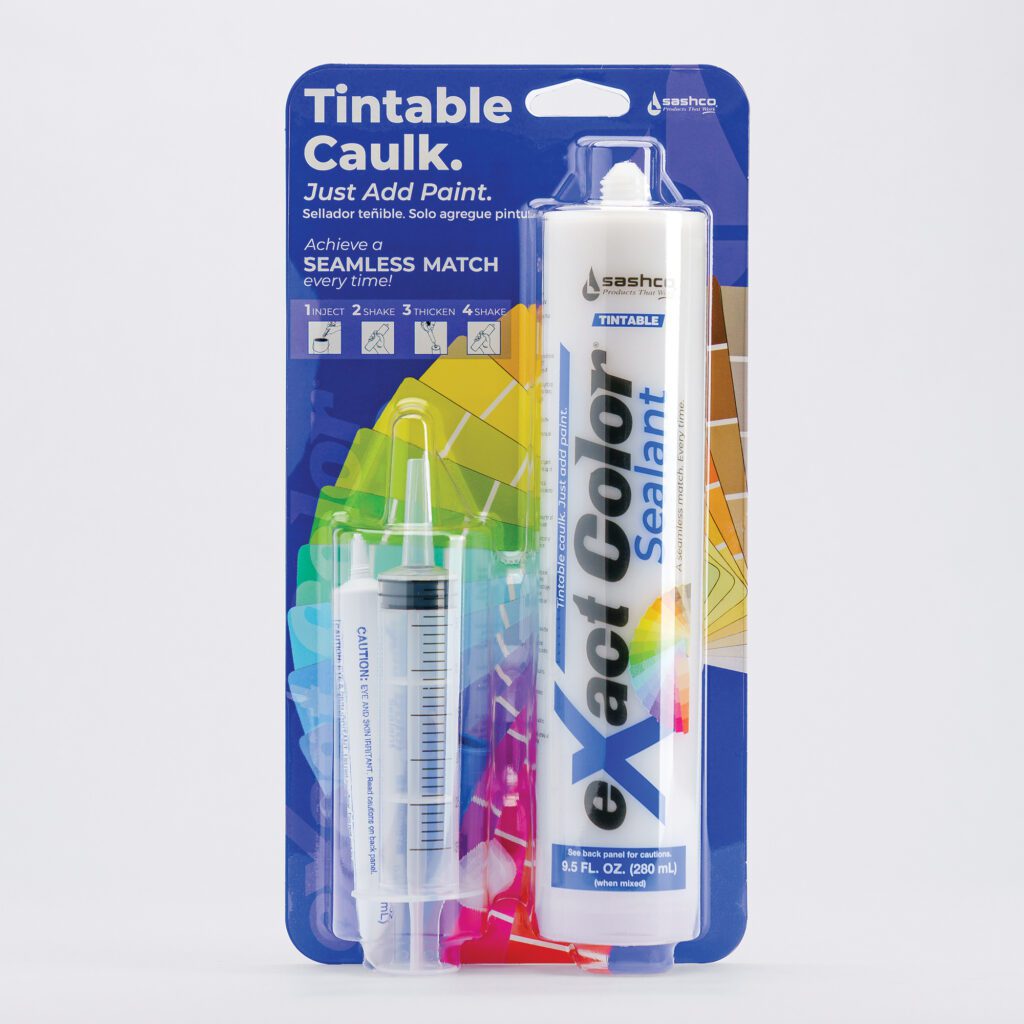
eXact Color® is Sashco’s color-matching system that allows you to create custom-colored caulking on-demand using the same paint or stain that you used on your project.

Instead of choosing from a limited set of pre-made colors, you choose your own paint (whether it be a solid color, a latex metallic paint, or even a semi-transparent stain).

And the result isn’t approximate-it’s exact.  Since it’s utilizing the same paint as the rest of your project, you won’t have to worry about it being “close.”  The caulking is built to accept paint and to dry down to the same color.  This system is built for pros, but easy enough for DIYers to use—to deliver that clean, professional look. 

How the System Works

1. Start with Your Actual Paint or Stain

Don’t rely on color names or swatches. Always use the real product that will be applied on the project.  Note that the paint you’re adding must be thoroughly mixed to be the same color as the rest of the project.  If you don’t mix the paint before adding it to the eXact color, you can’t expect it to match well.

2. Inject the paint into the caulking cartridge

After cutting off the tip of the cartridge, you add your paint into the cartridge using the supplied syringe.  It’s a straightforward (and somewhat fun) process, even without a medical degree. 

3. Mix Thoroughly

With non-white/gray colors, you can actually watch the paint work it’s way throughout the cartridge.  Look for the marbling to disappear as the paint mixes in completely.  You want one consistent color.  It usually takes about a minute of shaking the cartridge by hand. A fully blended cartridge ensures consistent color from the first bead to the last. 

4. Mix in the thickener

This is where many people cut corners—and it shows.  Once you’re happy with the color of the sealant from mixing in your paint, you want to add the thickener and mix it in as well.  It feels like the thickener is fully in there after just a few seconds…but keep mixing!  In this step, it also takes a full minute to get the thickener fully mixed in.  We’ll occasionally get folks who complain about the product feeling too thin…and it’s often the case that they under-mixed the thickener. 

5.  Wait

It takes 30 minutes for the caulk to develop fully.  Note that you can wait longer than that.  Lots of folks mix it up the day before the job.  Attempting to caulk before it’s ready can result in a product that feels too thin.

6. Apply

Once your color is dialed in:

  • Apply to clean, dry surfaces
  • Use proper joint design (backer rod when needed)
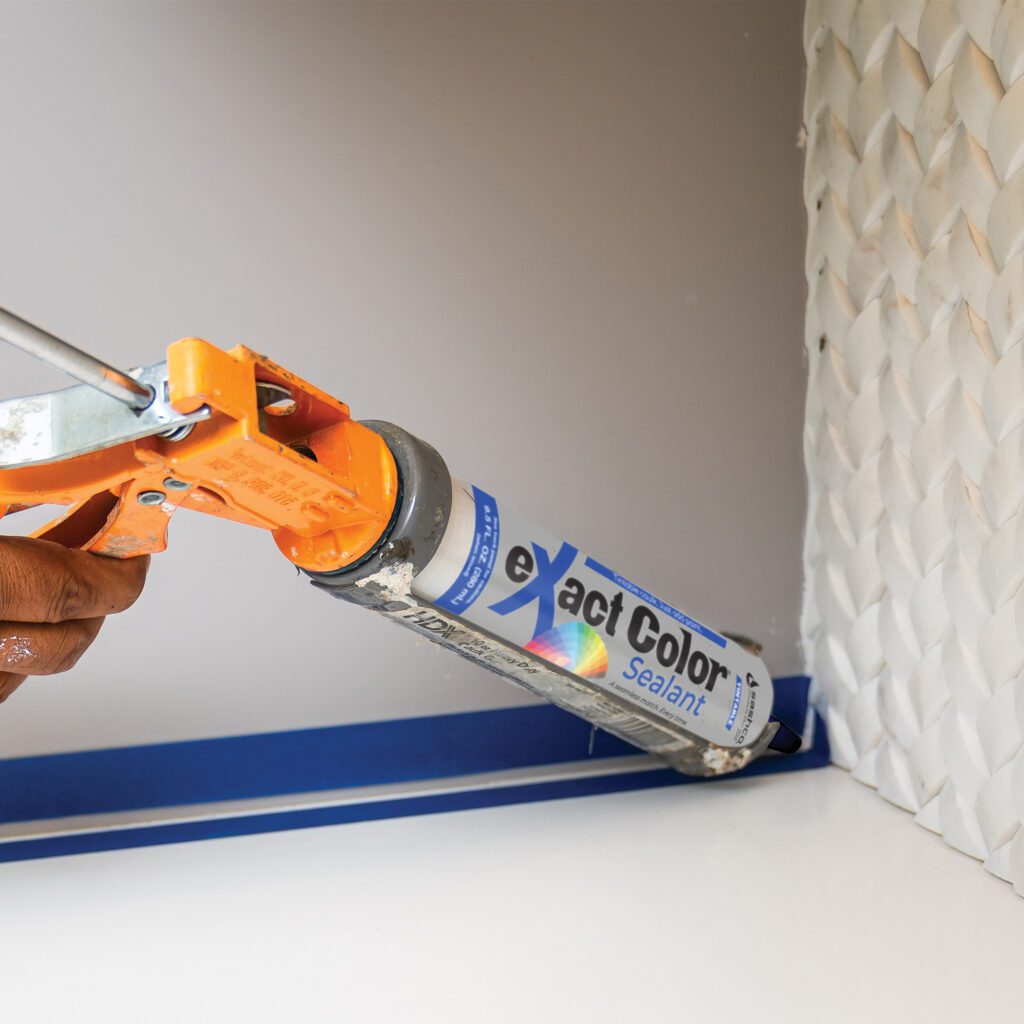
  • Tool the bead using a light, skimming touch combined with water or clear window cleaner to help get a clean bead

Even the perfect color won’t look good if the application is sloppy.

Where eXact Color Really Shines

The most common applications that I run into are siding, cabinets, countertops, and trim.  Getting a trim/backsplash connection the right color can be a bear, but not with eXact Color.  And if your caulking is failing in siding joints, simply mix in the exterior paint (it’s probably in a pail in the basement) and you can have the repair looking like it was done by a professional.  (Note that the paints you mix in to eXact Color must be water-based.  Oil and water don’t’ mix, so oil-based products won’t blend in with eXact Color). 

The Bottom Line

Custom color caulking doesn’t have to be a compromise anymore.

With eXact Color, you’re not having to guess or settle. You’re creating a sealant that matches your exact finish—while still delivering the performance you expect from a Sashco product that works.    

Why does Paint Crack when you paint over sealant?

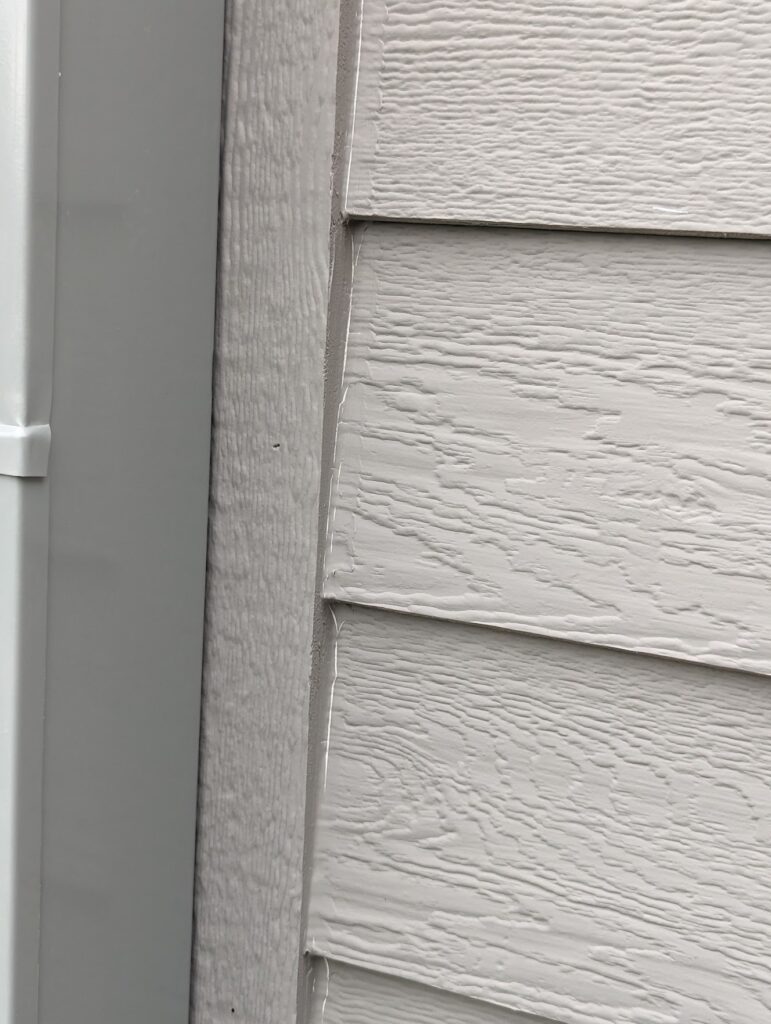
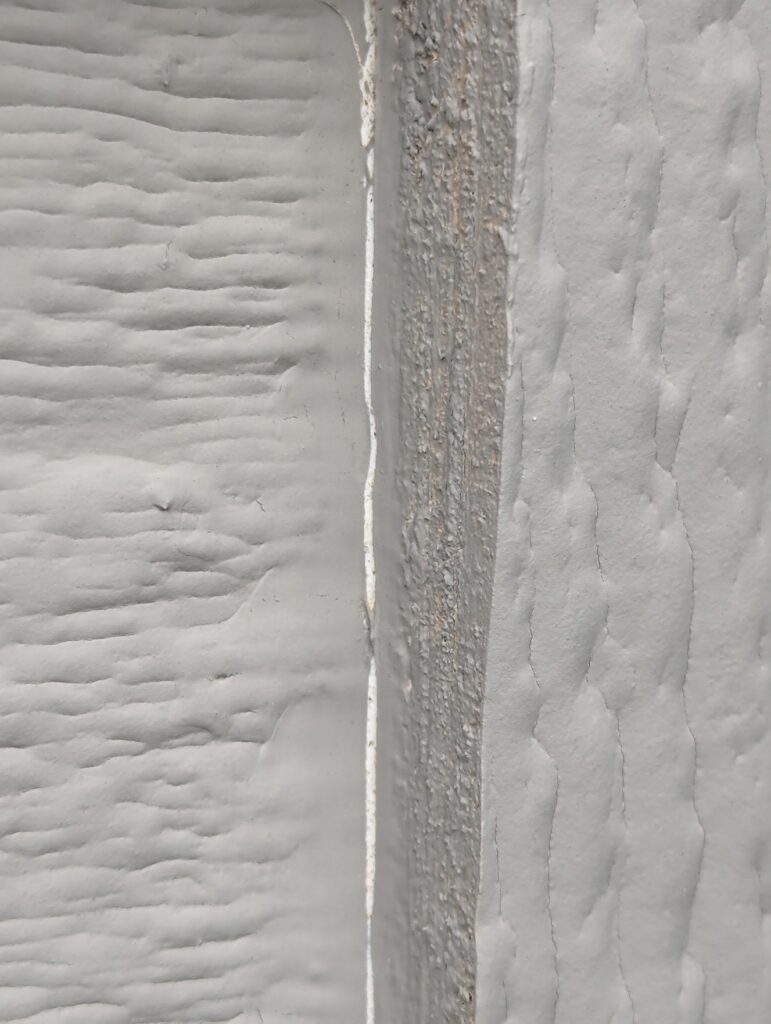
It’s important to understand what’s happening when paint cracks over a sealant. It’s probably being caused by one of these things.  Either…

  1. The paint was put on too soon or
  2. The paint isn’t flexible enough
  3. The sealant bead is too small
  4. The sealant is the wrong technology

To be clear, in both of these cases, we’re referring to a situation where the sealant hasn’t cracked…the paint has.  If you have cracked sealant, there are different things going on.  Let’s break down both scenarios.

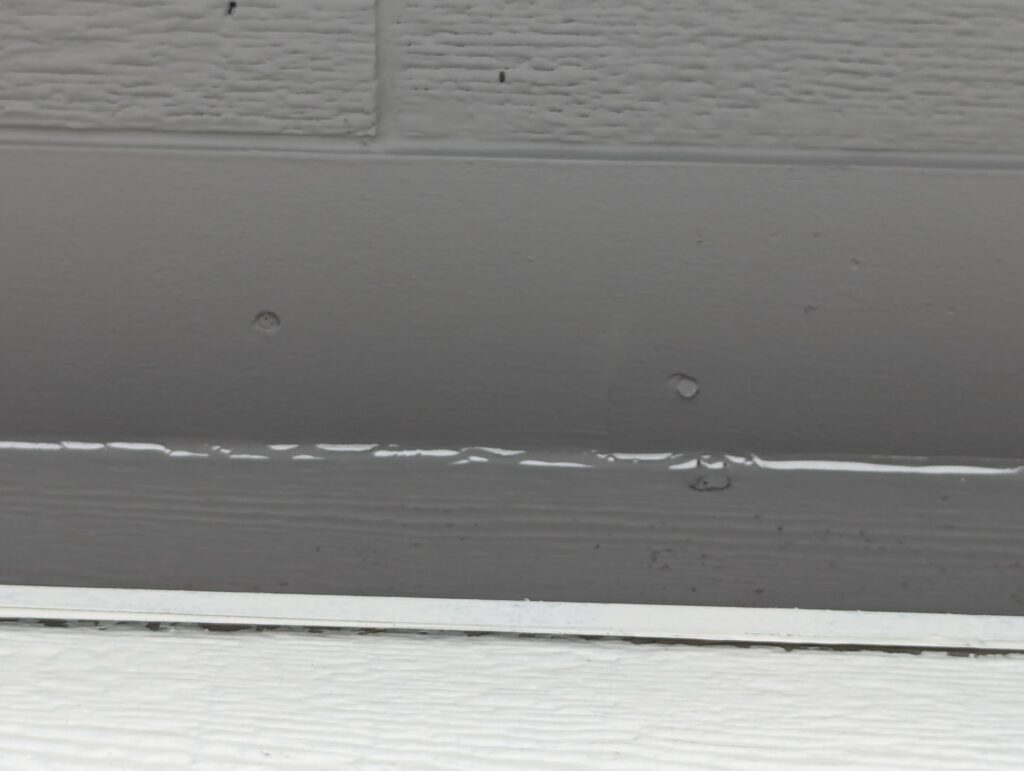
Most caulking shrinks as it dries.  There is water (or solvent) inside the caulking that leaves the film.  When this happens, the film naturally shrinks.  Because the bead is larger in the middle and thinner on the sides in a traditional joint, it shrinks the most in the middle to yield a concave appearance.  The sealant is designed to do this.  It’s been formulated to dry even when there’s a thick bead.  Paint isn’t.  Paint is designed to dry quickly.  If you put paint overtop of a sealant that is still shrinking, it automatically forces the paint to flex.  A high-quality paint might stand a chance, but a lot of them will fail within a couple days.  That’s actually how you can usually tell that this was the problem.  If the paint cracks in the first week, it’s probably from painting before the sealant was fully dry.

When a sealant is functioning properly, it’s moving.  A lot of paints just can’t move with the sealant.  This is especially true of the “highly filled” ones like primers and flat sheens.  The flatter a paint, the more likely it is to crack when applied over a sealant.  If nothing else works, try upping your paint spec to a higher quality or higher gloss paint.  It may just solve the issue.

This can be related to “scenario #2.”   The smaller the bead of sealant is, the higher the percentage of movement that you’re asking for when it moves.  For example, pretend that our siding moves ¼” every day.  If our bead is ¼”, then the bead has to double in length to put up with the movement of going from ¼” to ½” and back.  It’s moving 100% of it’s original length.  Now imagine the same joint except we have 1/8” bead of sealant.  Instead of moving 100% every day, it has to move 200% every day.  The sealant is probably going to be ok in both cases…but the paint on top of the sealant is being asked to do the same thing.  A bigger bead of sealant will make the sealant more durable…but it will also make the paint less likely to crack. 

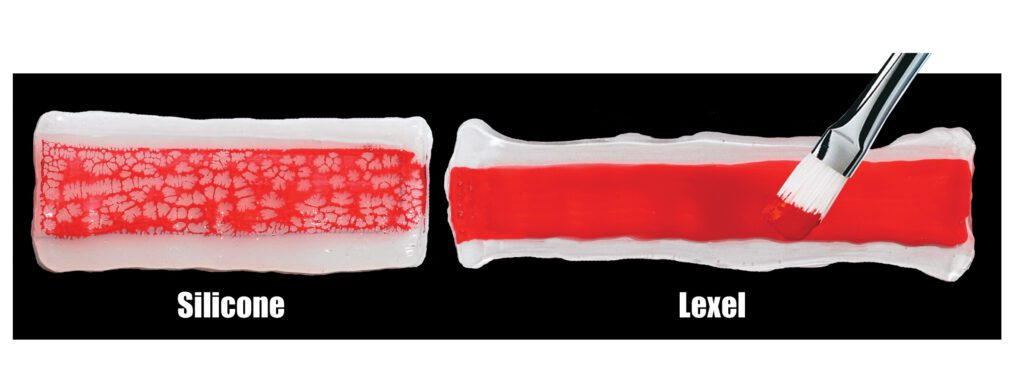
This one is pretty easy to diagnose.  Silicones are not paintable.  The failure won’t look like the images above…it’ll look more like this. Silicones are pretty easy to identify – they say “silicone” on the label.  If you find yourself in this situation, you’re in for a bit of a rough redo.  The process of removing a silicone is one we’ve covered before.  You can find it here.

So to ensure success the next time you are planning to paint your sealant, ensure that you use a fairly large bead, give the bead plenty of time to dry, and coat it with a high-quality paint.  You also have an alternative that could help prevent the issue in the first place.  eXact Color is designed to give you a perfectly-tinted color of sealant that you won’t have to paint.  You add the paint to the sealant instead of having to wait/come back to the job to paint it.  To learn more about eXact color, head here.

We’re an 87 years-young family company that geeks out over a better way to caulk and stain. Making a ‘Good, Better, Best’ product range just doesn’t turn our crank. We’re passionate about making the highest performance product possible for each project.

Order Caulk Samples

To request samples of our caulks and sealants, please join our SashcoPro Program.


Technical Product Inquiries

Call a specialist at 800-767-5656 or complete the Technical Inquiries form to ask a technical question.


Where to Buy

Find dealers near you and see which online retailers sell Sashco by visiting our Where to Buy page.


Check Out Our Videos

We geek out over sealant technology and high-performance building. Watch our videos to learn more.

Hey there, sealant and caulk enthusiasts! We’ve got some exciting news to share with you. We recently held an Open House event that marked the beginning of a new era for Sashco. And let us tell you, it was a doozy!

The event was held at our new headquarters in Thornton, Colorado, and was attended by customers, partners, and team members alike. The atmosphere was buzzing with excitement and anticipation for what was to come. And boy, did we deliver!

The Open House event featured presentations from Sashco’s leadership team, including the CEO Les Burch, who outlined the company’s vision for the future. And let us just say, it was an impressive vision indeed. “Our goal is to provide our customers with a better way,” Burch said. “We want to innovate and create products that solve their most challenging problems and exceed their expectations.”

We couldn’t agree more. And speaking of innovation, Sashco’s state-of-the-art research and development lab was open for tours during the event. Attendees got an inside look at the company’s product development process and the cutting-edge technology and experienced chemists and engineers that make it all happen.

But Sashco didn’t stop there. Interactive exhibits were set up for attendees to learn more about Sashco’s products and services.

The event was a success, and attendees left feeling inspired and excited about Sashco’s future. “The Open House event was a fantastic opportunity to learn more about Sashco and its commitment to innovation and customer satisfaction,” said one attendee. “I can’t wait to see what the future holds for this company.”

And we couldn’t agree more. With its commitment to growth, innovation, and customer satisfaction, Sashco is poised for continued success and is sure to delight its customers with a better way. We can’t wait to see what Sashco has in store for us next.

See how easy it is to mix Exact Color with Chris Berry, The Idaho Painter.

The color match possibilities are endless.

Discover the versatility and convenience of Sashco’s eXact Color Tintable Caulk with our comprehensive, easy-to-follow video tutorial. This video highlights the simple process of tinting Sashco’s eXact Color caulk to achieve seamless, color-matched sealing for any project.

Whether you’re a seasoned DIY enthusiast or a professional contractor, this guide will help you master the art of perfectly matching your caulk to your project. Get ready to explore the magic of Sashco’s eXact Color Tintable Caulk – the revolutionary product that can be custom-tinted to match any color you need.

In this video, we walk you through the process of tinting eXact Color to match your desired paint color.

With Sashco’s eXact Color Tintable Caulk, you’ll say goodbye to the limitations of standard caulk colors and hello to endless color possibilities.

If you have any questions about the product or the process, feel free to reach out. We love hearing from you!

Speak with a real human!

We’re here to help see your project through to the end.

Not sure which sealant, caulk, or other product is right for your job? Looking for the nearest location to buy products for your next home project? Don’t know exactly how to tackle your repair? We’re here to help.

Call to talk with one of our specialists:

800-767-5656

A Lexel case study-

Meet Cole.

He’s a law enforcement officer as well as a homesteader who lives in a small town outside of Des Moines, Iowa.

We found him on YouTube, invited ourselves to visit, and he graciously agreed. Cole took us around his homestead and showed us all of the places where he had applied Lexel to stop and prevent leaks.

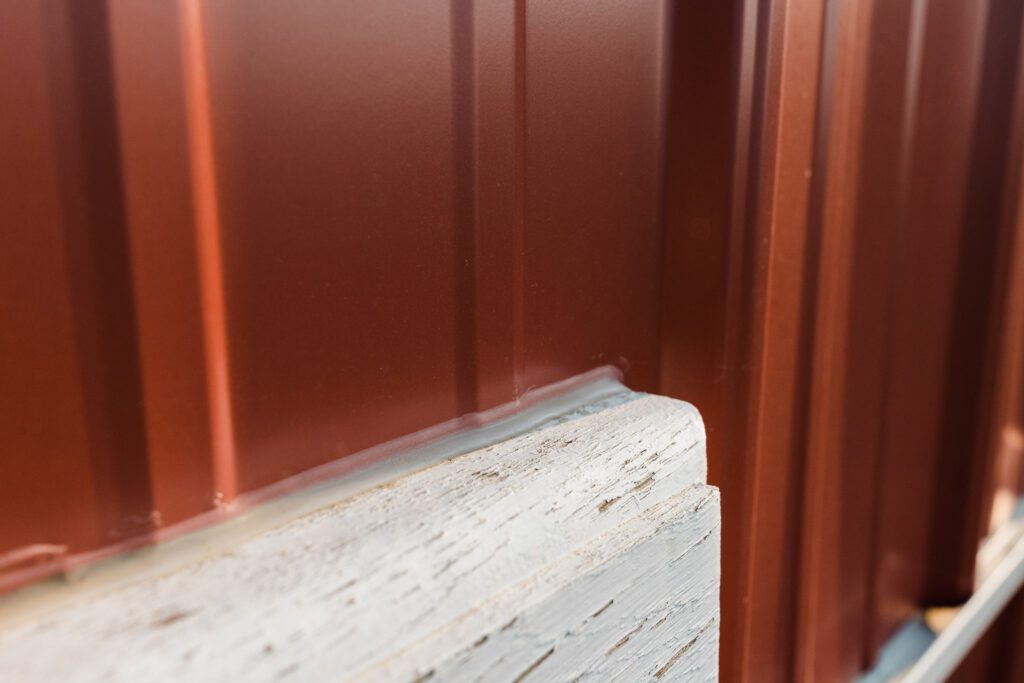
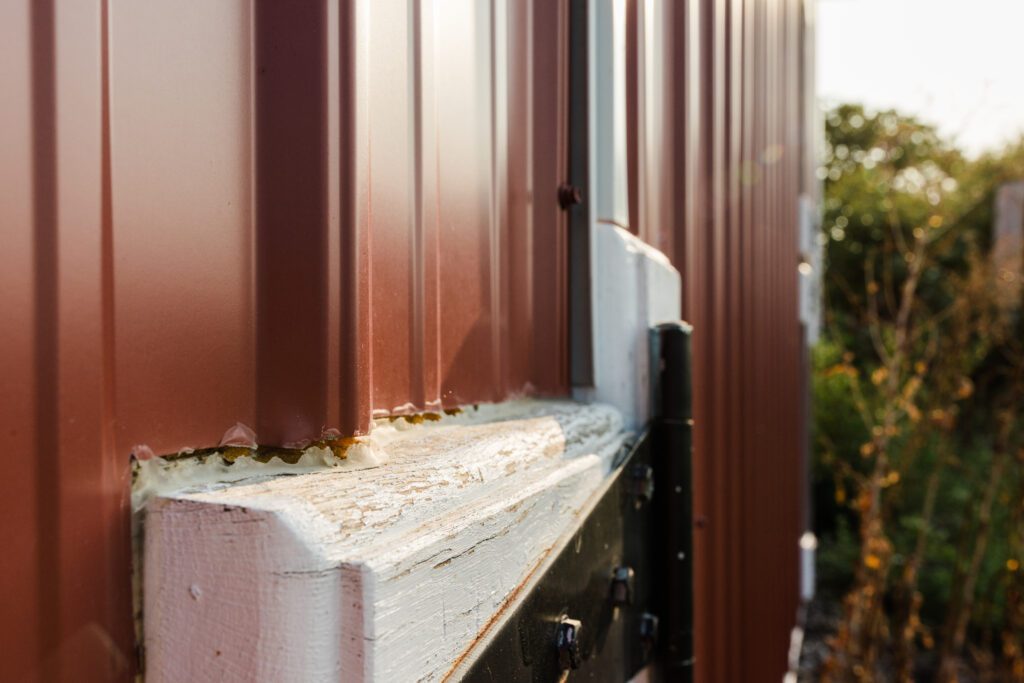
When we arrived, we first checked out the barn where, in 2018, Cole constructed blocks out of white oak to support the door hinges and handles and to provide a nice aesthetic against the red metal barn. Cole told us that he knew he would need to somehow prevent water from penetrating the seams, but he still wanted it to be aesthetically pleasing.  So, he was after a clear sealant that would allow his careful craftsmanship to show through. At the local hardware store employee’s recommendation, he purchased Lexel and applied it where the white oak wood blocks met the metal barn. During our visit, we were able to touch, see and feel the 4-year-old Lexel and could see and feel the moisture barrier it created. The blocks of wood where the Lexel was applied were still intact and showed no signs of weathering, thanks to the Lexel’s weather-resistant properties.

Not all seams on the oak blocks looked the same, though. Some of these things were definitely not like the others! Cole explained that during application, he ran out of Lexel, and in a pinch, he decided to use a different clear sealant that he had on hand to finish the job. Cole showed us where he had applied this other clear sealant. While it may have worked short-term in a time crunch, this difference over time between the two products’ durability was obvious. Here, a picture is worth a thousand words: 

Lexel vs Competitor:

Lexel

Competitive Product

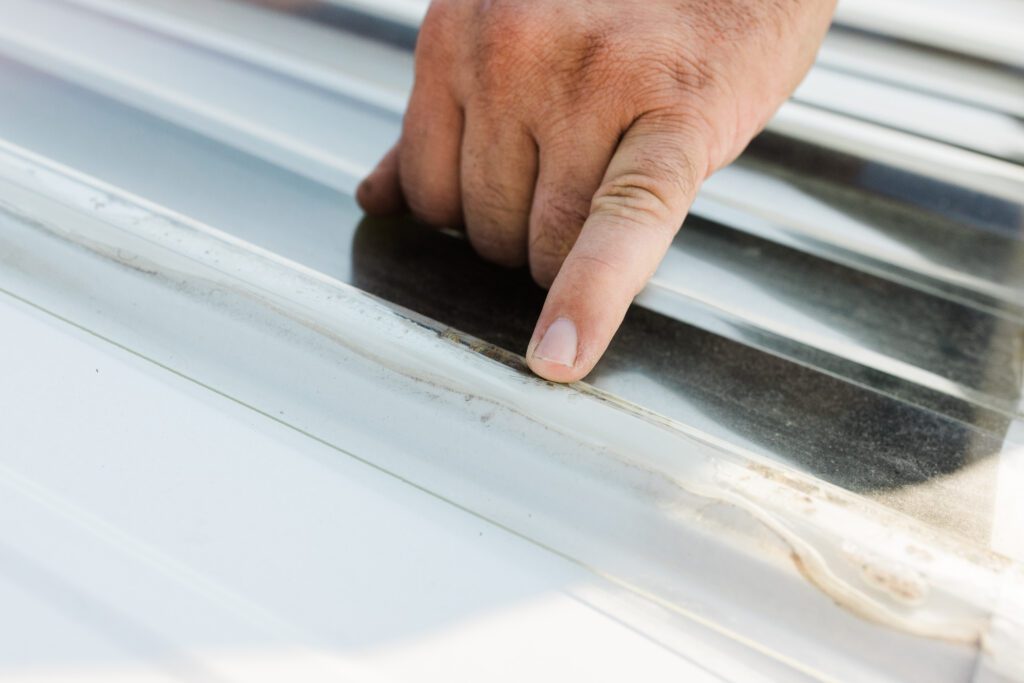
Next, Cole took us to the roof of his barn and showed us where he had sealed some skylights with clear Lexel. During installation, Cole bolted down the skylights, but also knew he wanted to seal them up tight for multiple reasons. First, he wanted to avoid water from seeping underneath the cracks where the skylight was bolted down, and second, he wanted to protect the interior of the barn from dust that gets stirred up by significant south winds which are common in Iowa. Cole showed us how the Lexel prevented any rain that hit the roof from seeping through cracks between the bolts. As we stood on his barn roof (on a non-windy day, of course), Cole physically pressed down with his fingers onto the skylight to also demonstrate where the dust would have entered the barn underneath the skylight seal had he not ensured a continuous seal using Lexel. He also noted, as he pressed with his finger, that even years after application the seal remained pliable and elastomeric underneath. He pointed and had us look closely as he showed us that we could quite literally see where the dust had blown up against the Lexel seal and stopped before getting under the window and into the barn. Pride of ownership was very apparent as Cole explained that sweeping out a dusty barn prevents him from doing other more important things on his busy homestead. 

It was such a privilege to visit Cole’s homestead and see a few of the application spots where he had used Sashco products to ensure superior waterproofing and air-sealing. Not everyone is as gracious when guests invite themselves to visit, but Cole was very welcoming, and we are humbled by his hospitality.   

Need more Lexel inspo? Let’s go.

Looking to learn more about the powers of Lexel?

A Lexel case study-

A Love Story.

Lexel is for lovers, and we have a story to prove it.

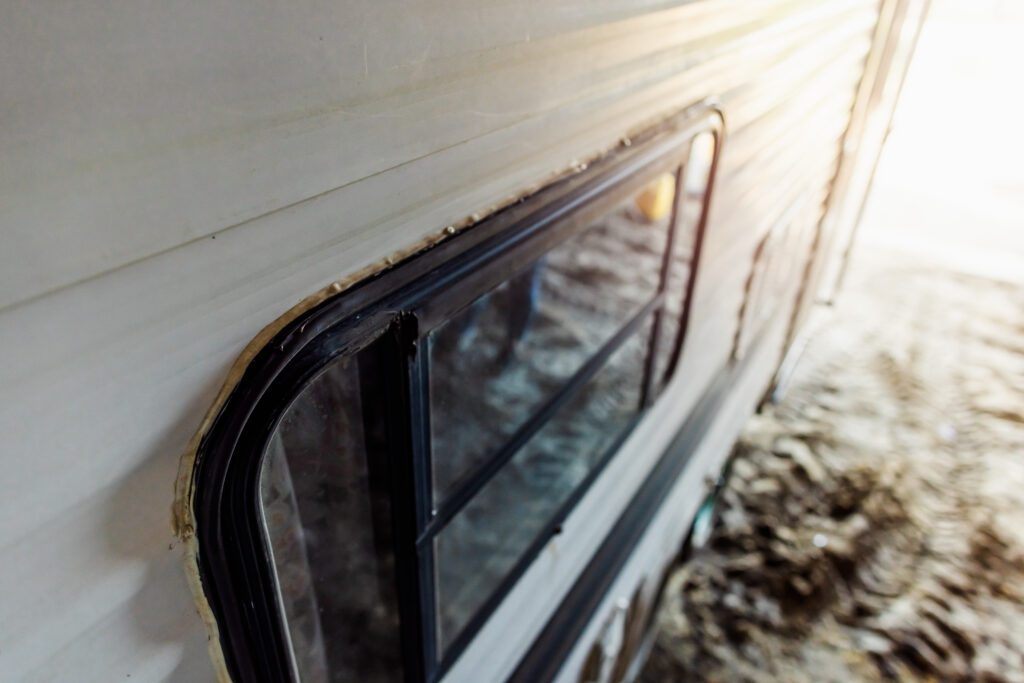
It’s important for the lifespan of your RVs and campers to preventively seal any potential moisture entry points before taking them out on trips. While we always recommend inspecting and locating potential entry points before your trip to the lake, sometimes you just don’t notice a leak until it is quite literally dripping on your head (or in this case, on your card game). Sashco’s Through the Roof and Lexel are heroes in this scenario. Both of these solvent-based sealants can be applied to an active leak and won’t wash away in the rain. Their superior adhesion qualities ensure that they stick the first time to your camper or RV and don’t require frequent re-application.  

This brings us to the time that we took a little trip to Iowa to visit one of our true Lexel Junkies that we stumbled upon while scanning YouTube one day.  We spent a day on Cole’s homestead where he showed us multiple scenarios in which he had used Sashco products to maintain his home and vehicles. He then told us a story about a time that he and his fiancé were on a weekend date/getaway in their camper. During the trip, they were inside playing a game of cards when the weather took a turn for the worse and a torrential downpour began. Water started seeping and dripping from the windows on their old camper. Cole, a natural storyteller, smiled and said,” I’ll never forget it. I come out here in the pouring rain and Nicole just watching from the inside of this window making fun of me”. He went on to explain that he sealed the active leak during the rainstorm- thanks to having a cartridge of Lexel in the truck.  Although he didn’t have a caulking gun handy, he grabbed a nearby stick and used it to push the plunger to get the Lexel out. Like a true hero, he saved the game of cards from becoming a soggy mess, while his fiancé chuckled and watched the fiasco in real-time from inside the camper. Cole also said that the rain actually may have helped him more easily tool the Lexel. We can’t help but wonder if Cole’s ingenuity and quick-thinking helped assure Nicole that she had chosen the right man and help seal the marriage deal (you never know, right?). The two are now happily married and Cole still has not had to re-apply the stick-applied Lexel after all these years. We think the big lesson here is to keep Lexel and a caulking gun in your camper, just in case (although Cole is living proof that where there’s a will, there’s a way).

Need more Lexel inspo? Let’s go.

Looking to learn more about the powers of Lexel?

Mike Bellevue feature

Every month we feature a contractor, business, or success story. Learning from others in the biz is the best kind of learning. Today, Mike Bellevue shares a few of the inside secrets to Chewelah Painting’s success.

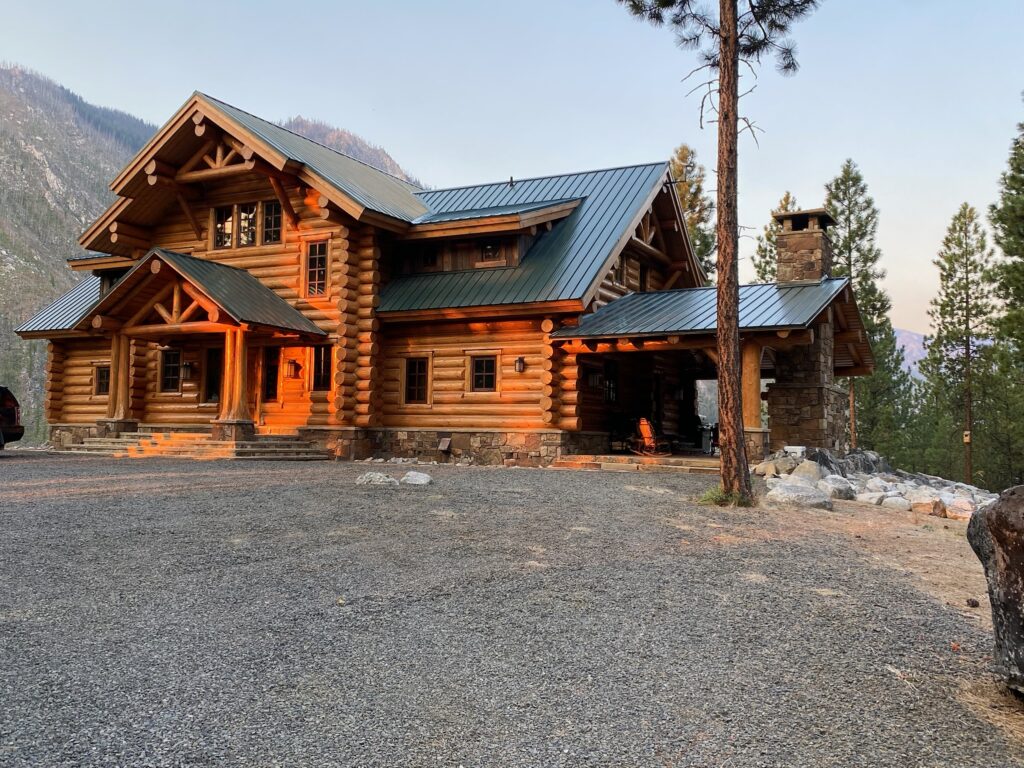
This month, we are featuring Mike Bellevue. Mike owns Chewelah Painting in Washington and has recently brought his log home finishing knowledge to Roe Paint in Idaho. Summer busyness is in full swing, so we’re grateful for the insights that Mike was willing to share about his business in the Pacific Northwest. 

How’d you get started in the log home finishing business? 

I am a carpenter by trade. I had every intention of working as a carpenter in Washington but was pulled into paint. We work in an area with a large number of log homes, and it wasn’t long before we worked on our first log home. The home came out great, but refinishing it was extremely tedious. Fortunately, I stumbled across Zero Failures and was blown away. Hands down the best training out there. I immediately bought a blaster and started marketing log home services. Three years later log homes became the majority of our work. 

How big is your crew now?  

We have five crews putting on coatings and working with several subcontractors.  Our sub-contractors are vetted and are a part of the team.  

What advice would you give to a newbie?  

Attend Zero Failures training and pay attention…then go back the next year and learn more. Pay attention in the classroom, but also pay attention to your work. You will learn something on every job and refine your process.  

What do you love most about log home refinishing? 

We are artists, but not in the traditional sense. We take a work of art and make it beautiful again. Each log blasts and stains differently depending on species, exposure, and a number of other factors. We learn something on every job. 

Mike, thanks for sharing a bit about your business. Feel free to look him up and pick his brain! 

If you are looking for some business tips to help you find the best clients, we have just what you need.

Let’s face it. All clients are not created equal. What’s good for your business goes beyond just bidding and winning jobs. The customer needs to be a good fit too. A critical skill in business is learning to go after customers and jobs that make your time and energy worth it. Learn to look for jobs that aren’t a drain, emotionally or financially. The truth is that there is more work than contractors right now. For you, that’s excellent news. And, these four top tips will help you find the best jobs and clients.

Will You Enjoy Working With Them

It’s okay to ask yourself if a potential client will be easy to work with and make the job enjoyable or if there are red flags that signal a nightmare scenario. If you suspect that you’re bidding on a job for demanding clients, it’s okay to walk away politely. Remember, find people who value the work you provide and are willing to work with you to get the job done. You have a helpful service to offer. Save your energy for the clients who value you.

Understand Who YOU Are Looking For

If you don’t know who your ideal target customer is, defining that is your top priority. How will you know when you find the best clients if you don’t know who you’re looking for? Take a moment to picture the perfect client and job. What’s it look like?

Ask yourself:

Having a clear strategy helps you reach your ideal client. You want to be a big fish in a small pond. Understanding your target market helps you get the potential customers you desire. Ultimately, building a business is about more than sales. Your goal should be to create something you enjoy and attract clients you want to work with.

Set Boundaries

Your clients want you to be in charge (even if they don’t know it). They hired you because they have confidence in your competence. It’s beneficial for you and them to set healthy boundaries for what’s acceptable and not while you work together.

Consider the Risk/Reward

It’s not uncommon for clients to look for contractors who offer ridiculously low prices. As a professional who provides products and services, that can be seriously frustrating. You provide good work and should be paid for the value you offer. The issue may be that you’re looking for business in the wrong places. Your goal should be to reach potential customers that understand your value. The internet is a blessing and a curse. Thanks to the old world-wide-web, everybody thinks they know everything, and they think they can get it done for pennies. This is not your ideal client. If a potential client’s first question is, “How much will it cost?” they are not your ideal client. Be picky about where you expend your time and expertise.

Rustic Park City feature

Can you tell us about your background? 

I started Rustic Park City in 2022 after working as the lead project manager for a prominent Park City general contractor for 6+ years. While working as a lead project manager, I learned rather quickly that my skills as a problem solver were well suited for this business. I also learned that I cared about meeting timeline commitments and budgets much more than most others in the business.  

How did you get started in log home finishing? 

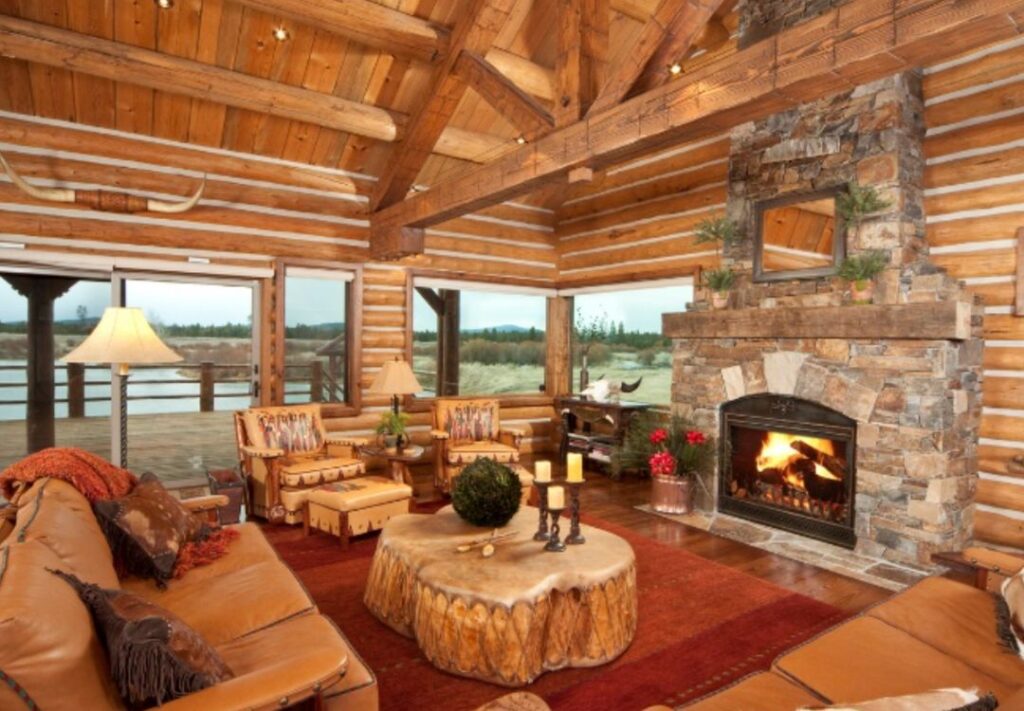
I bought a log home in the mountains near Park City and decided to take the restoration job on myself. I quickly realized that despite being a general contractor, I had a lot to learn. A local distributor, Wasatch Timber, helped me learn each step of log home restoration and muster the courage to point a blaster at my own home. As I restored the home, I fell in love with the details: the depth of the wood grain, the way the sun highlights the curvature of each log, the living character, and the rustic feel. I am standing here looking at it now. Sashco products made the home stunning. Living in a log home high in the mountains is the dream.  

Our slogan at Rustic Park City is “Locals Building Locals.” We are protective of Park City, but we want others to have the opportunity to live the dream as well. 

What advice would you give to a newbie? 

Don’t devalue yourself. We don’t lower our prices. If at the end of a project you can walk away proud of your work, then the homeowner will be proud of it too. Work with dignity and integrity. You are an artisan.  

We are builders by trade, not business owners. To start a business, you have to go out there and face your fears. Do one thing each day that moves your business forward. Face one fear each day.  

What does the future look like for Rustic Park City? 

I am legitimately scared by how quickly we are growing. I have built a team around me to support our growth. I have hired multiple accountants, business managements, and legal counsel. Without the team around me I am nothing more than a guy with a truck.  

Michael, thanks for sharing a bit about your business. Feel free to look Michael up and pick his brain!