The story behind restoring a 130-year-old Colorado mountain cabin.
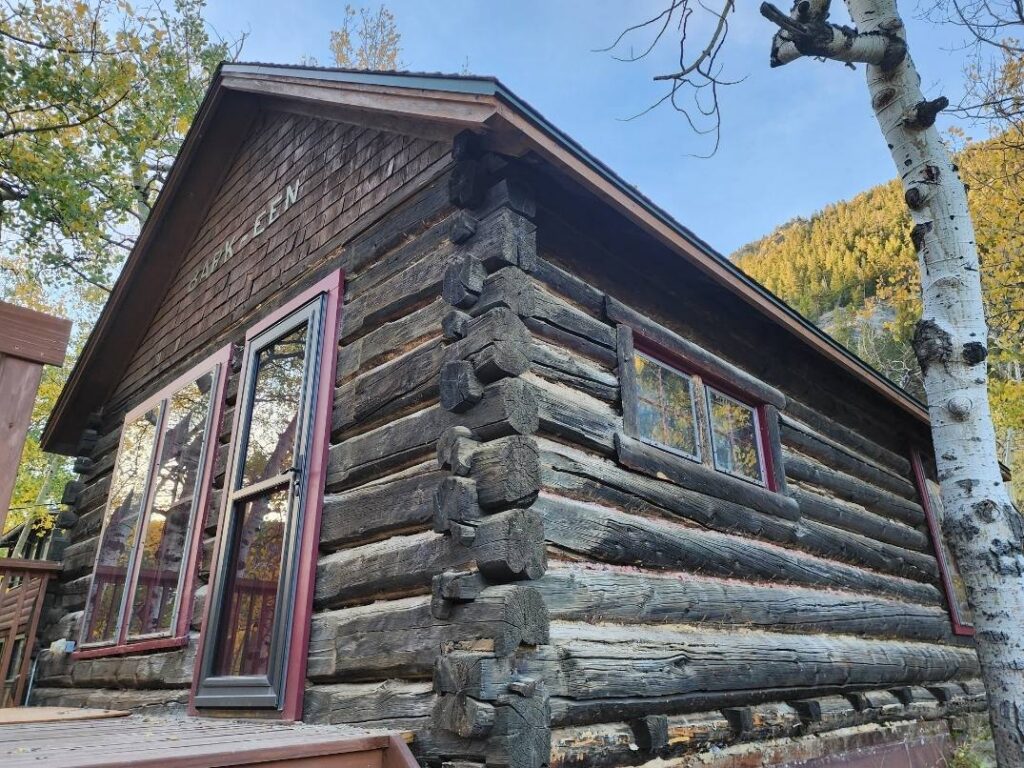
High in the mountains near Nederland, Colorado, sits a small log cabin with a long memory. Built sometime around 1890, the cabin originally belonged to a mining family named Barkeen. For decades, it stood high on the mountain while the family worked the nearby mines. Then, in 1950, the structure was moved down the mountain and rebuilt on a new site in 1953.
Seventy-five years later, time had taken its toll.
What followed wasn’t just another log home restoration job. It became a two-month effort to preserve a piece of local history and, in the process, add a new chapter to the cabin’s story.
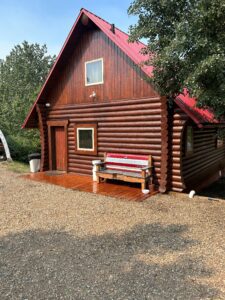
The Barkeen Cabin Before Restoration Work.
A Cabin Built for Mining, Preserved for History
Today, the cabin belongs to a man named Rich, whose family inherited the property through generations. Although the last name in the family line no longer matches the original Barkeen name on the cabin, the property has stayed within the extended family.
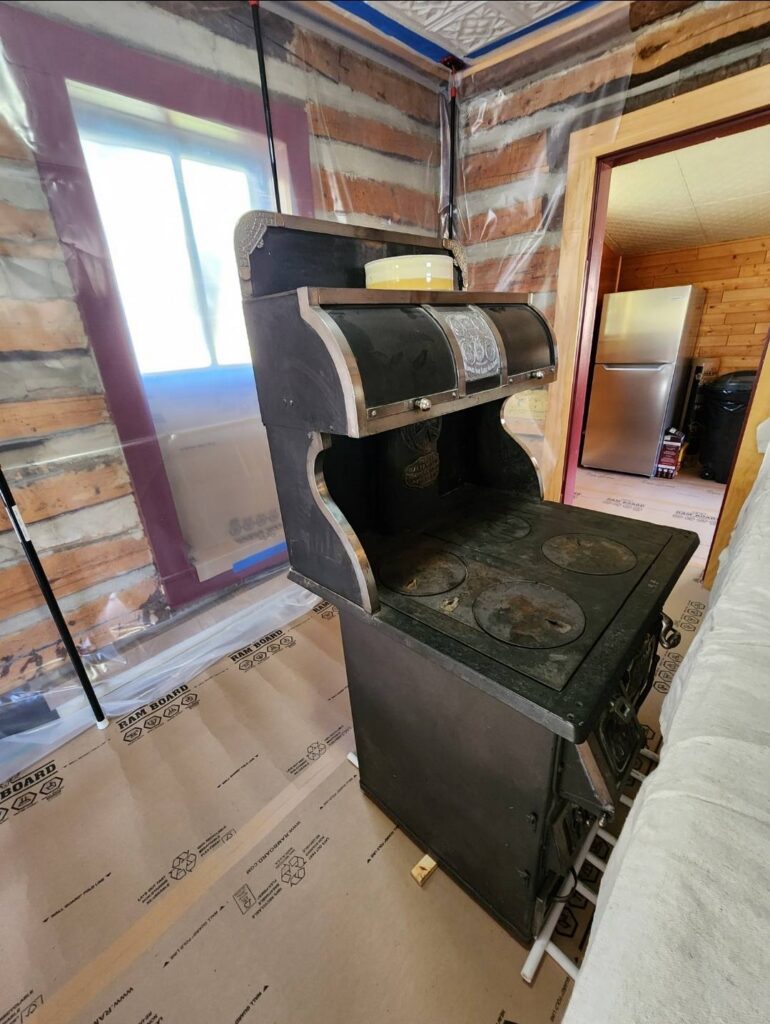
Rich has approached the entire property with a simple philosophy, preserving as much of the original character as possible. Inside the cabin, artifacts from the past fill the space, everything from historical pieces hanging on the walls to a vintage wood-burning stove that still carries its original crest and dates.
If something needs replacing, it gets replaced, but only with careful thought. Many of the people he hired to work on the cabin he describes not just as contractors, but as artists. One welder, for example, built a completely custom handrail for the flagstone path leading from the cabin to the road, something that simply couldn’t be bought in a store.
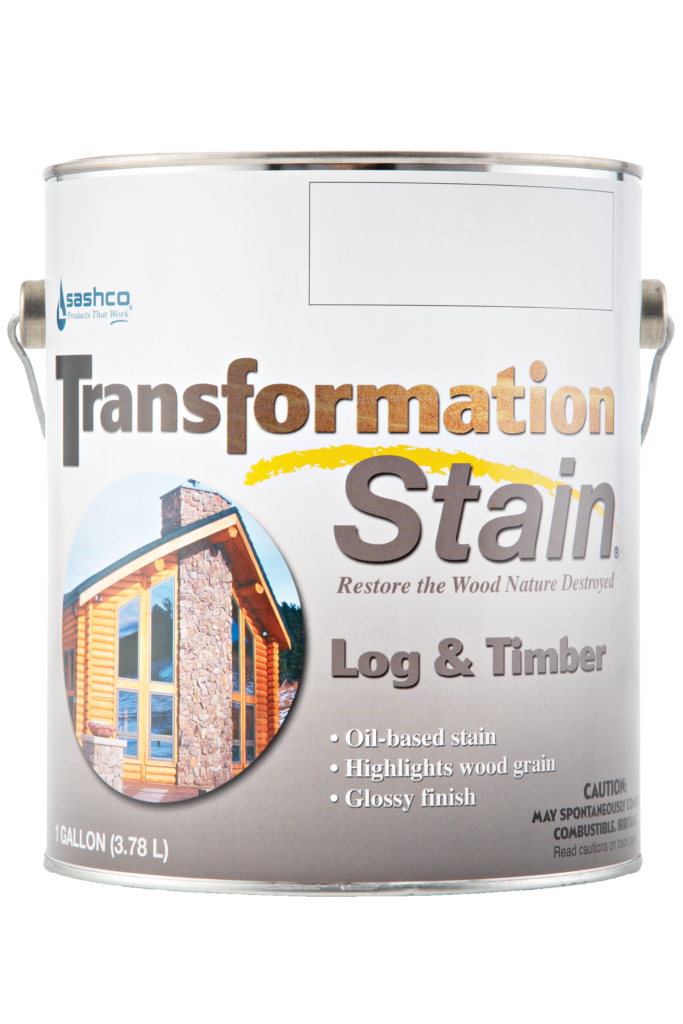
When Colorado Finish, LLC came in to restore the logs, the goal was the same: protect the structure while respecting its history. For the exterior finish, Rich chose Transformation Stain in Gold Tone Light, intentionally selecting a color that would bring the logs as close as possible to their younger appearance while still allowing the natural character of the aged wood to show through.
The goal was never to make the cabin look brand new. Instead, the aim was to honor the structure’s age while protecting it for decades to come.
Digging Out the Past, Literally
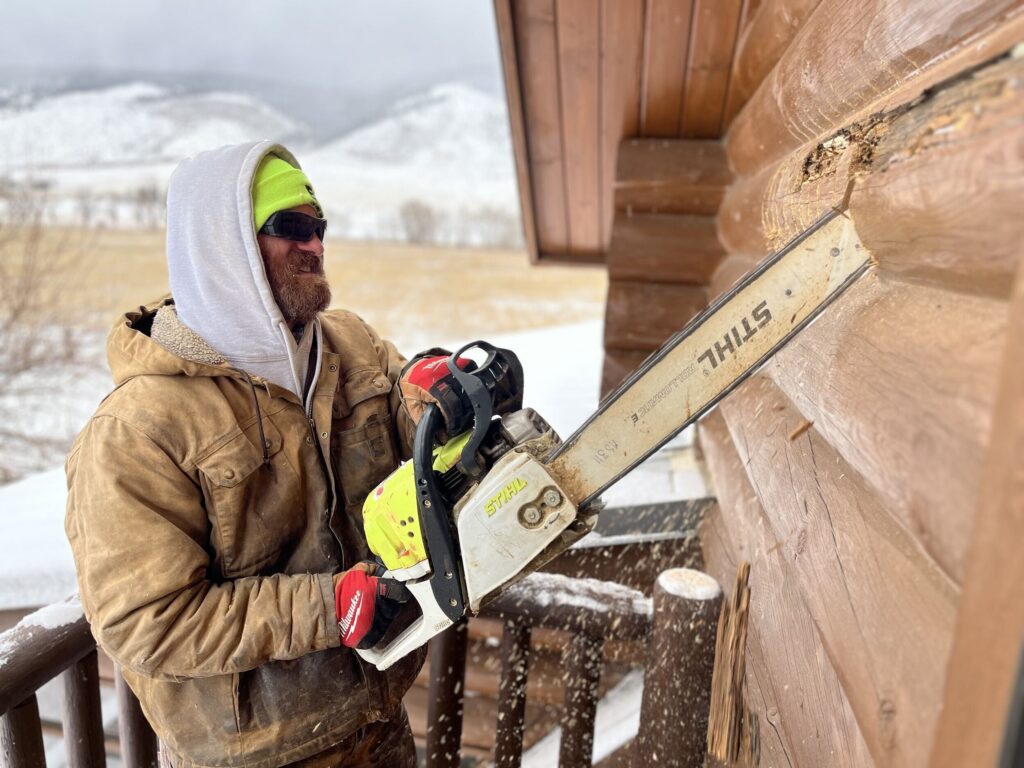
The restoration focused heavily on the cabin’s chinking, the material between the logs that seals the structure. Originally, the cabin used concrete chinking. After decades of weather and movement in the logs, much of it had begun to crack and crumble. Removing it was no small task.
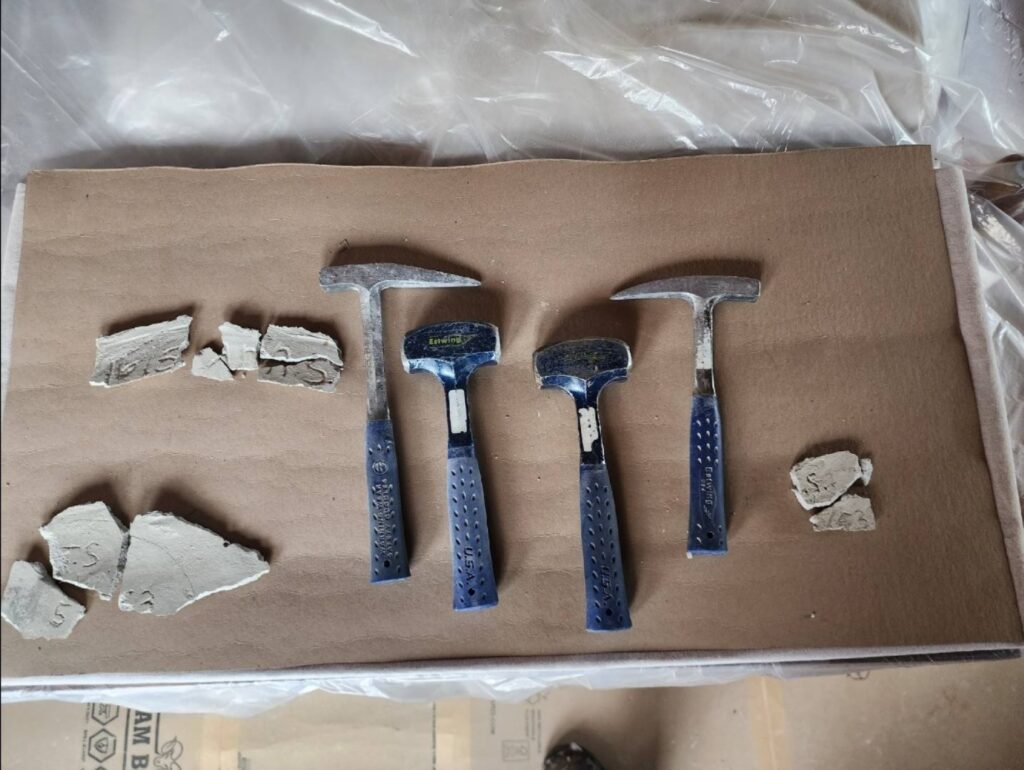
The crew spent weeks carefully chiseling the old material out of the logs. In several places, they discovered something incredibly cool and unexpected, handwritten signatures embedded in the original chinking from when the cabin had been rebuilt in 1953 (Goosebumps? Us, too!).
Pat, who owns Colorado Finish, LLC, understood the resonance it carried. He told us, “I had my pick and chisel, and I was trying to shape around the signatures,” he explained. “But the concrete was so old that a lot of it just crumbled away.” Still, he managed to recover fragments. At one point, he even assembled the broken pieces on a workbench like a puzzle, so the names could still be read.
Those signatures were a small reminder of the people who had worked on the cabin decades earlier, workers whose efforts were now being revisited generations later.
Tools used to carefully work around the original signatures.
When Snow Becomes a Work Tool
The restoration happened in late fall, and the timing turned the project into a well-planned and thought-out winter adventure.
Pat and his crew finished the exterior just before the first snowfall. But when they returned the following week to begin work inside, the mountains had other plans. Two feet of snow had fallen. The cabin was buried.
The crew shoveled their way inside and got to work, but another challenge quickly appeared. They needed to remove piles of old concrete from the cabin interior. Normally, that kind of debris gets hauled away in wheelbarrows or tarps. Not this time. Instead, Pat improvised.
“We actually brought toboggan sleds,” he said. “There was so much snow outside that we were sledding loads of concrete down to the truck.” Chunk by chunk, the old material slid down the hill on sleds before being loaded into the truck and hauled away. It wasn’t the most traditional construction method, but it worked.
And it added a memorable moment to an already unusual job.
The Cabin Earns Its Place in History
After the restoration was complete, the cabin reached an important milestone; it officially received historic landmark status. For Rich, that meant the preservation effort had succeeded.
For Colorado Finish, LLC, it meant something else as well. This was the first officially registered historic landmark they had restored, a personal milestone in a career spent working on log homes.
But the most meaningful moment came when the final work was finished. When Pat discovered the signatures of the workers who rebuilt the cabin in 1953, names that had lasted for generations hidden inside the walls, he added something of his own. He added his own signature.
“I think it’s pretty cool how you can do a job like that,” he said, “where you’re trying to preserve someone’s signature from decades ago, but then you leave your own behind for the future. My signature will be on that wall for at least another 50+years to come and won’t have to be touched.”
Placed on the interior where it will remain protected, his name now joins the earlier builders as part of the cabin’s continuing story.
Some jobs are just construction projects. Others become something more. For Pat, restoring the little Barkeen family cabin wasn’t just about repairing logs and sealing gaps. It was about helping preserve a place that holds generations of memories and leaving a small mark of his own in its long history.
Ready to stain? Don’t guess! Sample. Testing stain colors on your actual logs before committing ensures that you get the exact look you want and helps prevent “oops” moments later. Snag your free samples here.
When it comes to protecting and beautifying your log home, Sashco isn’t just another stain on the market — it’s the high-performancechoice for serious log lovers. With industry-leading products like Capture, Cascade, and Transformation, Sashco combines cutting-edge technology and rugged durability to keep your logs looking stunning and standing strong year after year. Whether you’re chasing that perfect finish or just want to avoid the heartbreak of costly repairs, Sashco’s got your back. Because your log home deserves more than “good enough,” it deserves Sashco. Made for logs. Made to last. Made to make your neighbors jealous.
If you hang around the log and timber frame restoration world long enough, you start to notice a pattern. The most successful contractors aren’t the loudest marketers or the cheapest bids. They’re the ones who quietly, consistently do the hard things the right way, even when it’s inconvenient, expensive, or takes longer to explain to a homeowner.
On paper, they’re known for handling some seriously large, complex projects across Montana and beyond. We’re talking about 10,000-20,000 square feet of wall space, two-tone finishes, brutal weather windows, historical cabins miles from the nearest hotel. But when you sit down and talk with them, the reason for their success has very little to do with square footage and everything to do with how they run the business.
They Don’t Sell Jobs. They Sell Long-Term Relationships.
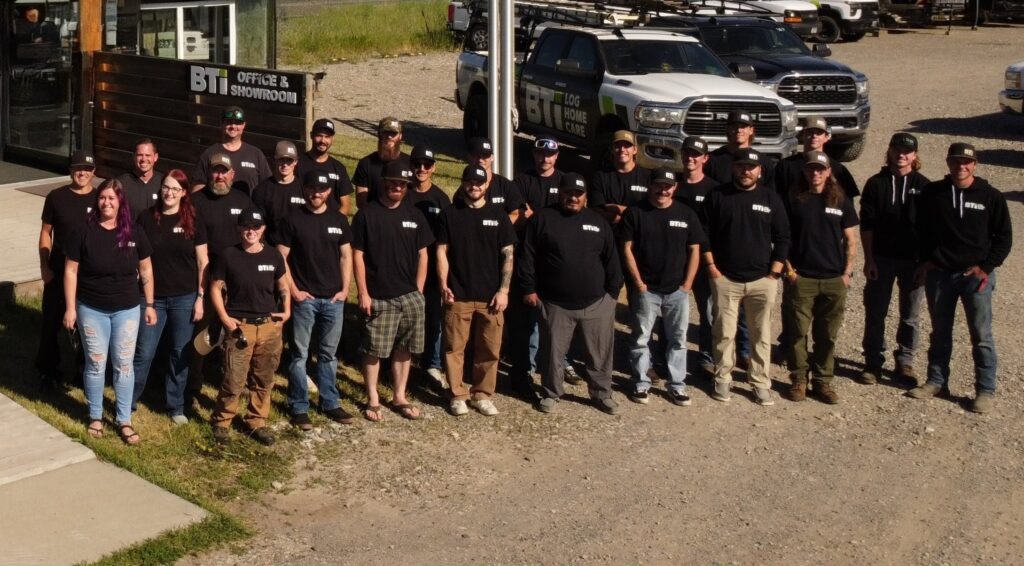
The BTi Log Home Care Crew.
We recently talked to the leadership team at BTi Log Home Care, and one thing came up again and again. They are fully committed to relationships with their clients long after the project is done.
That sounds simple, but it’s a radical mindset shift in an industry where plenty of contractors hope they never hear from a homeowner again once the final invoice is paid. These guys are the opposite.
They actively design their process around maintenance, education, and repeat interaction. In fact, they’ve started including the first year of maintenance directly into their restoration project, not as a sales gimmick, but as a way to remove friction and reset expectations.
The message to homeowners is clear, “We’re not disappearing. We’re coming back. And that’s a good thing.”
That approach does two important things for business. First, it builds trust, because maintenance conversations stop sounding like upsells. And second, it protects the original restoration work (and their reputation).
As Cal Arnold, owner of BTi Log Home care said, “We don’t want to be the contractor who stains your house and hopes we never have to talk to you again.” That mindset alone explains a lot about their longevity.
Prep Is Non-Negotiable (Even When It Costs Them Jobs)
To someone new to the industry, it might look like BTi Log Home Care makes success effortless. It would be easy to assume their advice would center on building a massive team, pouring money into flashy marketing, or chasing the latest business buzzwords. But that’s not their approach. Ask BTi Log Home Care what matters most for someone starting out, and you won’t get a glossy answer. You’ll get one word: Prep.
Surface prep, process discipline, and refusing to cut corners (even when, ahem, especially when homeowners ask for it). They were blunt about this part. Not knowing any better, clients will encourage shortcuts. They’ll ask for wash-and-recoat jobs. They’ll compare cheaper bids. But BTi made a deliberate business decision to walk away from jobs that don’t align with their process. Not because they don’t need the work, but because they understand the downstream cost of a compromised reputation. That discipline has paid off.
Today, they maintain client relationships that stretch back decades. Homes they restored 20 years ago are still on their schedule. That kind of continuity doesn’t come from shortcuts. It comes from holding the line when it would be easier not to.
They Match Products to People (Not Just to Wood)
Here’s where their operational maturity really shows. They don’t just evaluate wood species, exposure, or climate. They evaluate people.
If a homeowner is honest about not wanting (or not being able) to maintain the home annually, they adjust product choices accordingly. If someone is detail-oriented and committed to upkeep, they’ll lean into systems that reward that discipline. That means fewer failures, fewer uncomfortable conversations, and fewer unrealistic expectations.
It’s also why their projects age so well. Cal told us that, “Even when homeowners push maintenance longer than recommended. The prep, application, and product selection are dialed enough that five years later, the home still looks “pretty darn good.” Even if it’s filthy.”
And yes, they’ll still gently remind you that paying for maintenance now beats paying for refinishing later. Let’s just say that root canals were mentioned. We’ll spare the analogy> Let’s just say, brush your teeth.
Big Jobs, Small Jobs. Same Emotional Buy-In
While they’re known for massive, high-profile projects, some of the work they’re most proud of is far smaller. They reminisced about historic cabins, family properties, and places with emotional weight.
In one case, they restored a 1913 Forest Service cabin covered in dust from the Mount St. Helens eruption still clinging to the walls. The job required travel, camping, and working during the early uncertainty of COVID. Not glamorous. Very meaningful. The result? Tearful voicemails from homeowners. Relief. Gratitude. And a structure preserved for future generations.
What matters from a business perspective is this, their entire team understands that they’re not just fixing logs, they’re protecting family legacies. That belief shows up on large modern builds, too. Even when the project doesn’t scream “sentimental,” there’s always a person behind it. A family. A future burden removed.
That kind of emotional buy-in is hard to fake and impossible to scale unless it’s baked into company culture.
Trusted by Builders When It Actually Matters
One of the strongest indicators of their success isn’t a logo or an award, it’s who calls them when the stakes are high.
On a recent large-scale project in Big Sky, the homeowner was prepared to remove and replace all exterior siding. Instead, this crew stepped in with a restoration plan that saved the structure and delivered a standout two-tone finish with Capture Log Stain in Weathered Wood on the body and Capture in Aspen Bark for crisp white accents.
The general contractor backed them fully. In fact, the contractor made it clear they’d charge more if they had to use anyone else. That’s not about price. That’s about trust.
When builders know a contractor will follow process, protect the homeowner’s investment, and execute under pressure and weather constraints, they stop shopping bids. They pick the team that won’t create problems. Pretty cool stuff.
BTi Log Home Care
Why They Align with Sashco (And Why That Actually Matters)
Partnerships get thrown around a lot in this industry. Usually what that means is a logo on a website and a discount sheet in a folder. That’s not what’s happening here.
The alignment with Sashco works because it mirrors how these guys already run their business.
First, the obvious one reason is that processmatters. Sashco systems reward contractors who prep correctly, apply correctly, and follow the rules. If you’re looking to cut corners, the products will absolutely let you know. That accountability fits a company that has zero interest in fast, cheap wins.
Second, maintenanceis engrained into their philosophy. These restorations don’t look good just on the day they’re finished, they look good years later because the system is designed to be maintained, not ignored. That supports the exact conversations they’re already having with homeowners about long-term care, realistic expectations, and avoiding the dreaded full refinish.
Third, education trumps hype. Sashco’s approach, especially in pro-to-pro environments like Zero Failures, matches how this team operates internally. They don’t pretend problems don’t exist. They talk about them, study them, and build systems to avoid repeating them. That’s why they’re bringing entire crews to training instead of just sending one manager and hoping the message trickles down.
Finally, there’s the durability factor. When a home can go longer than it should without maintenance and still hold together, it’s proof that the prep, products, and application were right from day one (obligatory statement: don’t neglect it, it’s still not worth it). That kind of real-world performance protects everyone involved: homeowner, contractor, and manufacturer.
Why They’re Still Winning
Strip away the job sizes, the colors, the equipment, and the square footage, and the reason for their success is refreshingly straightforward:
They protect their reputation aggressively
They educate instead of overselling
They build systems that support maintenance, not neglect
They care deeply about the people behind the projects
BTi Log Home Care is built on principles that don’t go out of style. And in an industry where failures are loud and success is often quiet, that might be the highest compliment you can give a contractor.
Since 2002, BTi has been setting the standard in log home care. What started as a soda blasting service evolved when founders Cal and Lee Arnold identified a critical need for superior finishes and lasting protection. Today, our mission remains the same: deliver the highest-quality, most beautiful, and longest-lasting solutions for our clients.
Ready to stain? Don’t guess! Sample. Testing stain colors on your actual logs before committing ensures that you get the exact look you want and helps prevent “oops” moments later. Snag your free samples here.
When it comes to protecting and beautifying your log home, Sashco isn’t just another stain on the market — it’s the high-performancechoice for serious log lovers. With industry-leading products like Capture, Cascade, and Transformation, Sashco combines cutting-edge technology and rugged durability to keep your logs looking stunning and standing strong year after year. Whether you’re chasing that perfect finish or just want to avoid the heartbreak of costly repairs, Sashco’s got your back. Because your log home deserves more than “good enough,” it deserves Sashco. Made for logs. Made to last. Made to make your neighbors jealous.
A weathered log home gets a full structural and aesthetic revival using Sashco’s CPRCleaner, Capture in Mahogany, Cascade Semi-Gloss, and Conceal in Redwood.
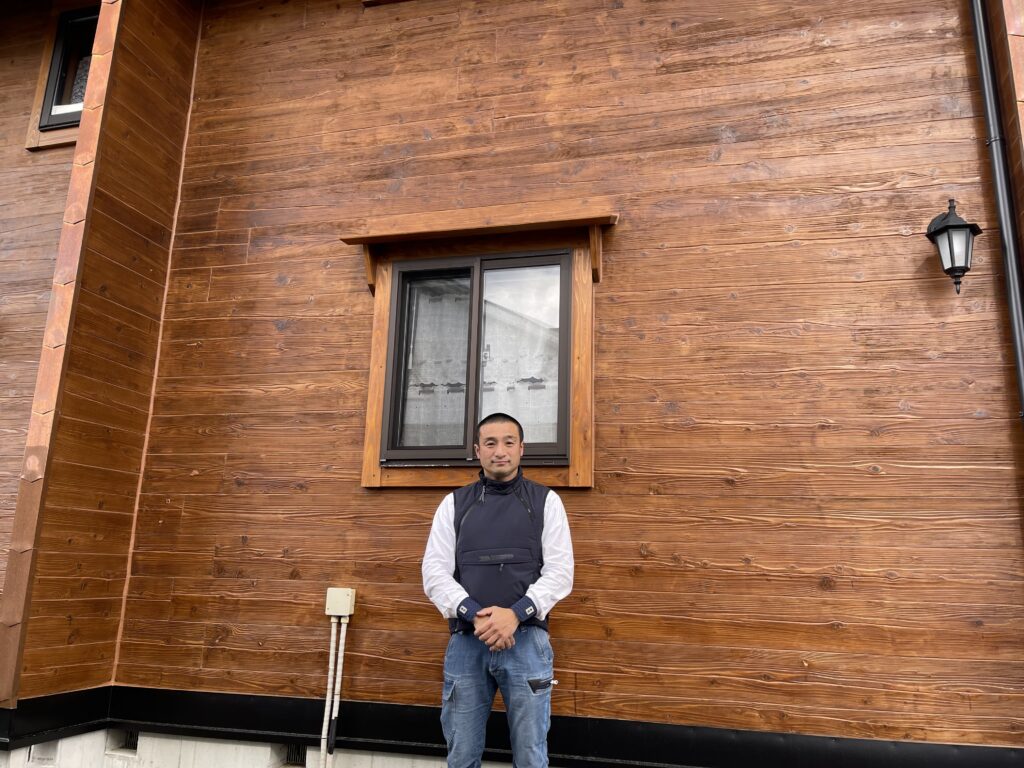
Mr. Murasawa in front of the home
Occasionally, a restoration project comes along that reminds you why wood homes captivate us in the first place: their character, their grain, and the sense that they’re part of a story much bigger than just lumber and nails. That was certainly the case here.
This wasn’t a small facelift or touch-up. This was a total restoration of a weathered log home in Japan. And like so many projects that begin with visible wear and hidden damage, it became a powerful reminder that restoration is possible when you’re willing to do the work the right way.
The project was undertaken by Mr. Murasawa, a contractor who works withNikken-Sogyo, Ltd., a distributor of Sashco’s products in Japan. What started as a mission to improve aesthetics quickly became a full-blown revival of both structure and testing the soul.
Days of Weather, Wear, and Water
By the time the restoration team arrived, years of exposure had taken their toll. Old coatings had failed. Log connections and notched joints were letting in rainwater. Sealants had deteriorated. Some log sections were so compromised that they needed replacement outright.
This is the moment many owners wonder if a home is simply too far gone. But time and again, we see the same truth play out: with effort and the right techniques, rarely are they beyond hope.
The original caulking had failed, which lead to interior water staining. The exterior stain was faded and there was significant mold growth on the surface. This home needed some SERIOUS TLC.
Deep Surface Prep
The first major task was preparing the wood itself (and this was serious work).
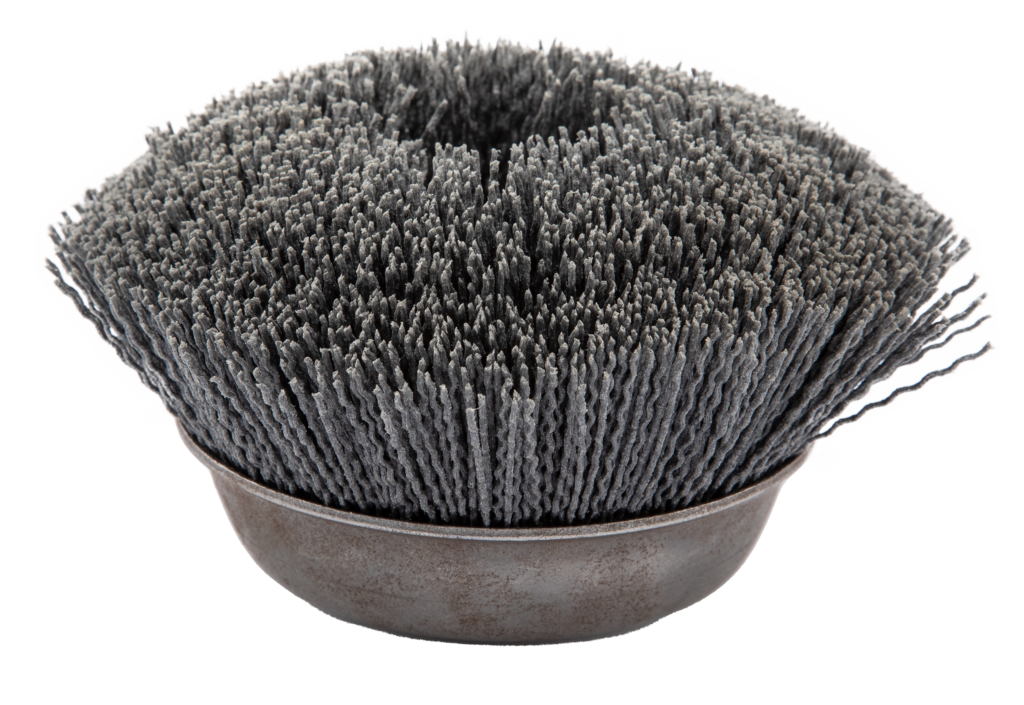
To start, existing coatings were stripped off using a #120 nylon brush with wheel sanders and grinders. But this wasn’t just about removal. By sanding perpendicular to the grain, the team enhanced the natural log texture, removing softer earlywood and revealing the denser latewood beneath. The result? A beautiful uzukuri (means wire-brushed, also, a super cool word) texture that made the grain stand out in a way that typical sanding by hand never could.
Aside from aesthetics, this uzukuri surface also improved the mechanical adhesion of the Capture and Cascade, which is a crucial foundation for any lasting restoration. When the surface is right, everything that follows works better.
Over One of the biggest challenges uncovered during the restoration was rainwater intrusion at critical joints, openings, and connections. Instead of patching the symptoms, the team went after the cause (because we’re not into Band-Aids).
All old sealants were carefully removed, and deteriorated logs were replaced where needed. At the log end grain sections, new wooden backing was installed and wrapped in copper sheeting designed to echo the look of tree bark (off-the-charts cool factor). Not only was that an aesthetic dream, but it was also a solution that improved waterproofing while staying visually true to the surrounding logs.
For the inevitable checks and cracks in the logs, Sashco Concealin Redwood was used to fill and seal to leave a natural, seamless finish that blended into the wood.
This kind of work isn’t flashy, but it’s exactly what makes long-term success possible. Fix what’s wrong, respect the structure, and move forward knowing restoration really is possible.
The Look and Protection Combo
Now for the part people really notice. The color!
The team chose Sashco’s Capturein Mahogany. The color is a rich, deep tone that highlights the wood’s natural grain while offering excellent UV and weather protection. The color brought warmth and depth back to logs that had seen years of hard exposure.
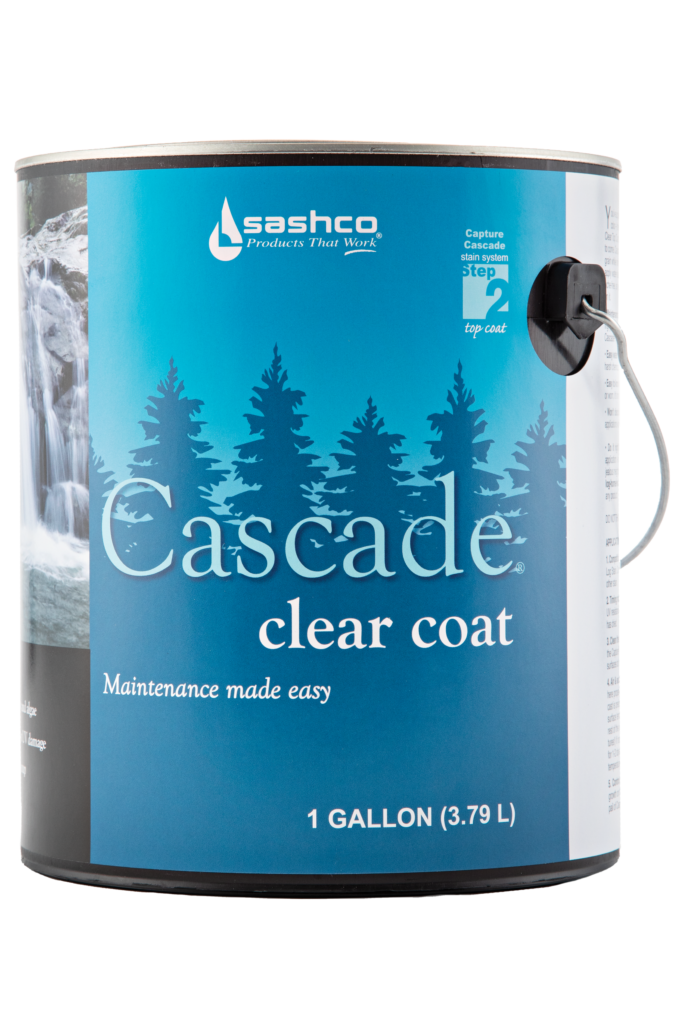
Once the stain was applied and dried, Cascade Clear Coat in Semi-Gloss was added as the clear topcoat. This final layer enhances color clarity and sheen while providing long-term resistance to moisture and weather, helping ensure this restoration lasts for years to come.
What Happens Next?
True restoration doesn’t end when the last coat dries.
A future-focused maintenance plan was put in place with annual inspections, prioritizing areas previously affected by decay and those most exposed to wind and rain. By watching these areas closely over time, small issues can be addressed early, keeping the home protected and the envy of all the neighbors, year after year.
This project was never just about products. It was about commitment. Commitment to doing the work thoroughly, respecting the original structure, and choosing systems designed to work together over time.
With careful surface preparation, thoughtful structural repairs, and the combined use of Conceal (Redwood), Capture Log Stain in Mahogany, Cascade in Semi-Gloss, and CPR Cleaner, this home didn’t just get a second chance. It became one more real-world example that with the right approach, the right products, and the right people, restoration truly is possible.
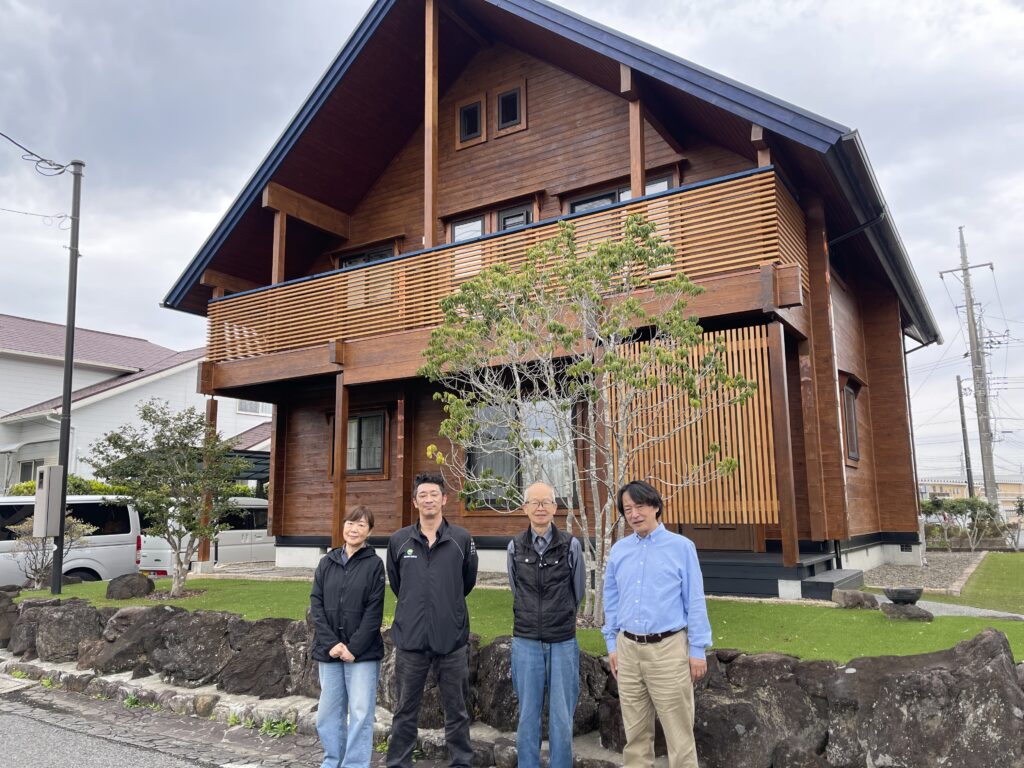
Home during restoration processFinished home. Standing from left to right is Nori from Nikken, Tomoji from Nikken, Mr. Nishiuchi the Homeowner, and Nozomu from Nikken
Ready to stain? Don’t guess! Sample. Testing stain colors on your actual logs before committing ensures that you get the exact look you want and helps prevent “oops” moments later. Snag your free samples here.
When it comes to protecting and beautifying your log home, Sashco isn’t just another stain on the market — it’s the high-performancechoice for serious log lovers. With industry-leading products like Capture, Cascade, and Transformation, Sashco combines cutting-edge technology and rugged durability to keep your logs looking stunning and standing strong year after year. Whether you’re chasing that perfect finish or just want to avoid the heartbreak of costly repairs, Sashco’s got your back. Because your log home deserves more than “good enough,” it deserves Sashco. Made for logs. Made to last. Made to make your neighbors jealous.
Here We Go…
Every fall and again in early spring, the phone starts ringing.
Homeowners and contractors alike are racing the calendar. Some are trying to wrap things up before winter really settles in. Others are itching to get started because the sun is finally shining again. And almost every conversation begins with the same question, “How cold is too cold to chink or stain my log home?”
The honest answer is this: it’s not just about the air temperature. It’s about the surface temperature of the logs, the product’s temperature, and how well the work is protected during curing. Ignore any one of those, and you’re not just cutting corners. You’re taking a real risk on a costly redo.
The Biggest Danger Is the Wash-Out
When it comes to chinking and sealants, the greatest cold-weather threat is wash-out.
In normal temperatures, chinking skins over fast enough to withstand a light rainstorm. But cold weather dramatically slows the curing process. If rain hits before the material has had time to firm up, it can literally wash a beautiful joint right down the wall.
That’s not just frustrating. We’re talking days of lost labor, wasted material, and a mess that’s nigh on impossible to just clean up. Cold temperatures won’t always “ruin” the product itself (although that’s also a risk!), but they delay when it becomes weather-resistant, and that delay is where the danger lives.
Wash-out doesn’t just mean reapplying. It often means cleaning residue off logs, re-prepping joints, and explaining unexpected delays to the homeowner. In cold weather, one storm can undo several days of work.
Surface Temperature Matters Just As Much As Air Temperature
One of the most misunderstood aspects of cold-weather application is that the log’s surface temperature matters just as much as the air temperature.
On a 40°F day, sun exposure can push log surface temperatures well over 100°F. On the other hand, a cloudy 45°F day after freezing weather can leave logs far too cold for proper adhesion. A good, simple rule of thumb is that you want a surface temperature of at least 40°F (and rising) and no more than 90°F (and falling) before you even think about applying chinking or stain. Use an infrared thermometer and check it often. Guessing isn’t good enough when the stakes are this high.
Air temps matter, too. Even if your logs are warm during a 45°F day, they’ll drop pretty dramatically at the end of the day and overnight. So, overnight air temps need to be 40°F or better for a minimum of 2 days after products have been applied.
Keep the Product Warm, Not Just the Logs
Cold chinking is thick, sluggish, and difficult too. Worse yet, when it’s too cold, it can struggle to adhere properly to the surface.
A trick many experienced pros rely on is storing their materials in a small room or closet inside the structure, sometimes with a small space heater. You don’t need a sauna; just enough warmth to bring the material itself up to 80–85°F.
One tricky thing to remember, though, is that bringing a five-gallon pail from 35°F up to working temperature can take several days, not a couple of hours. Planning ahead here makes all the difference. Forcing cold material to work faster often leads to uneven joints, poor tooling, and inconsistent appearance. Even if it sticks initially, long-term flexibility and performance can be compromised. It’s just not worth it.
Tenting and Heating Are Often the Real Secret to Success
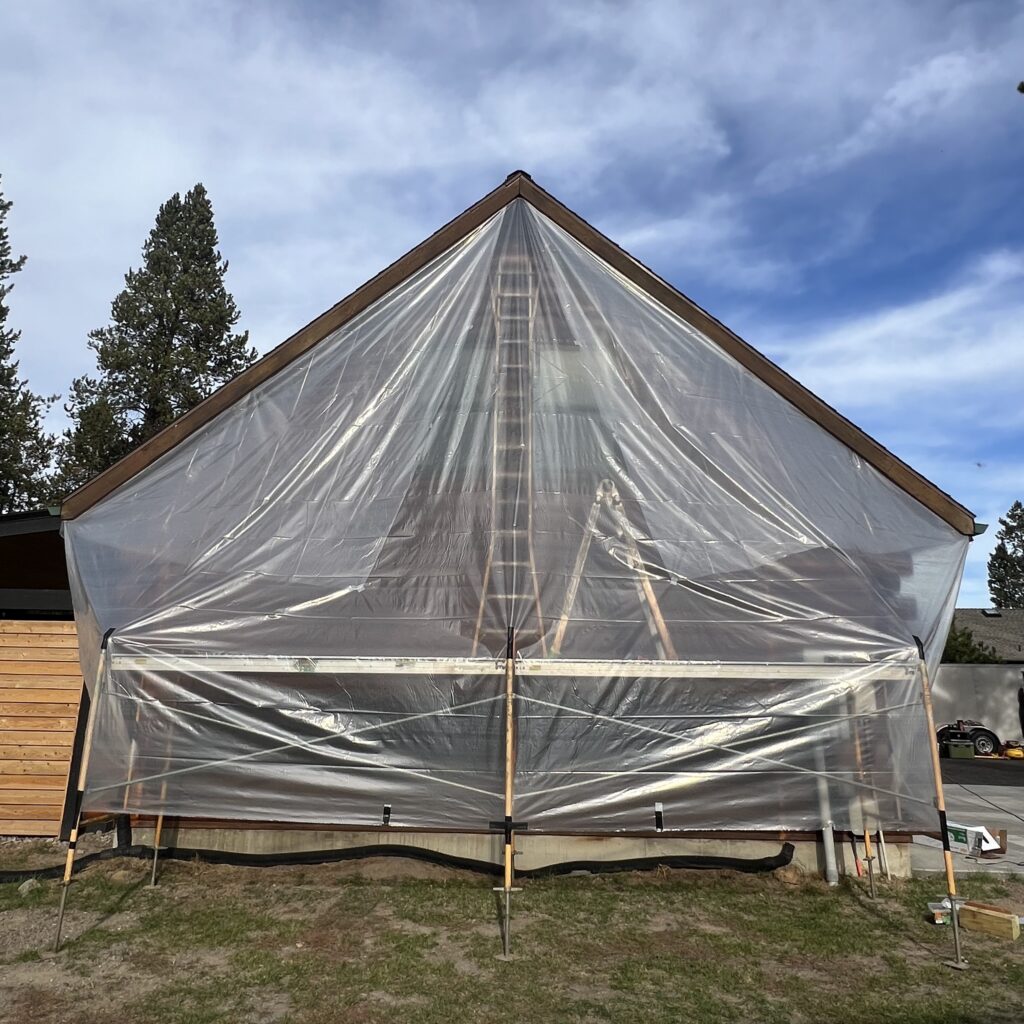
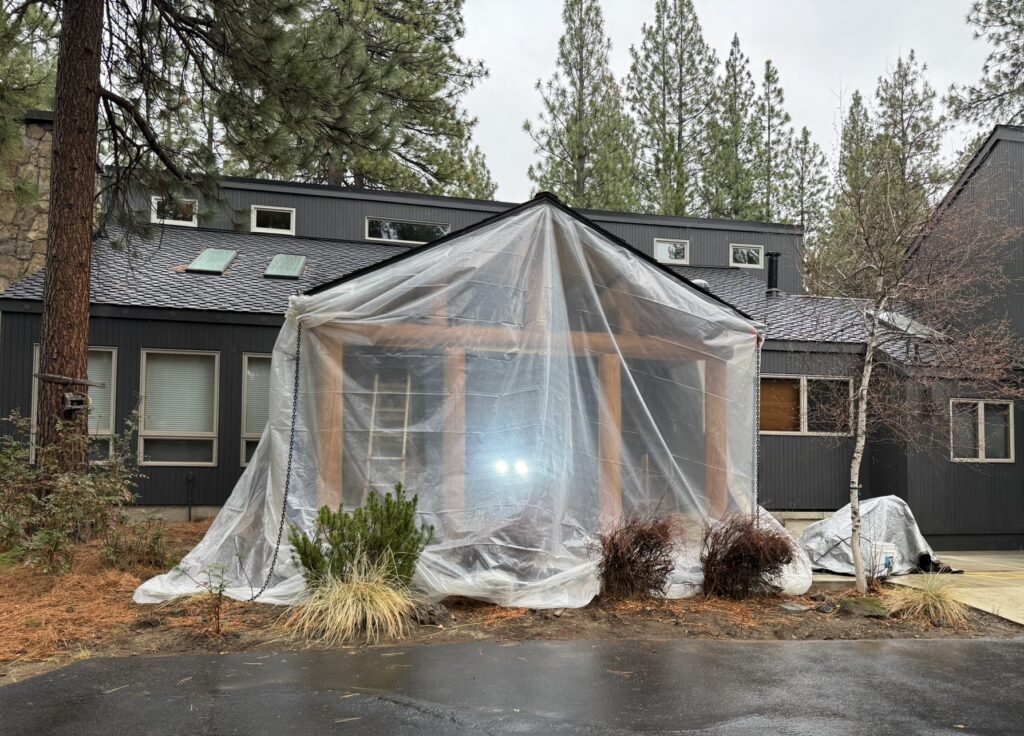
In cold weather, tenting isn’t optional. It’s what makes proper application possible.
Clear plastic sheeting works exceptionally well because it traps solar heat, lets in natural light, and creates a controlled environment around the work area. But tenting alone isn’t enough.
You also need air circulation. Without venting, moisture can build up on the logs and cause condensation, which can lead directly to the same wash-out you’re trying to prevent. This is important because tenting isn’t just about temperature, it’s about stability. Consistent conditions allow products to cure as designed, reducing callbacks, repairs, and long-term failures that are often blamed on the product instead of the environment.
Done correctly, tenting and heating protect both the material and the craftsmanship behind it.
Mother Nature doesn’t always cooperate, so we adapt without compromising quality. Proper tarping, airflow, and heat management ensure coatings bond correctly even in cold-weather applications. Photos courtesy of Knaughty Log
Official Cold-Weather Guidelines for Log Jam
We like to have fun around here, but when it comes to pushing cold-weather work, that’s when we get serious. The instructions for Log Jam are clear for a reason.
To safely apply Log Jam in cold weather:
Log surfaces must be above 40°F (4°C). Always confirm with a surface thermometer.
Air temperatures must be above 40°F, as well
Keep chinking warm until it’s ready to use
Logs must be completely free of frost (frost prevents adhesion)
Tent the area with clear plastic and heat it before and during application
Provide air circulation to prevent condensation
Leave the tent and heat in place for 2–4 days after chinking (use the full 4 days for wider joints)
Then remove the tenting to allow normal curing
Here’s the reality check. In cold weather, Log Jam will take much longer than usual to fully cure. Don’t go out there and test the limits. Removing protection too early is one of the most common cold-weather mistakes. Even if the surface feels firm, the material underneath may still be vulnerable to damage from cold, moisture, or movement. Trust us on this one!
What About Staining?
Many of the same principles apply to stains like Capture Log Stain and Transformation Stain.
Cold temperatures slow everything down:
Cold wood slows (and can even prevent) penetration and adhesion
Cold stain doesn’t flow or level as well
Curing takes much longer
Uncured stain can remain tacky
Keeping the stain warm, monitoring surface and air temperatures, and using tenting and heat, when necessary, can make cold-weather staining successful, especially with water-based products.
Don’t Be Fooled by “Freeze-Thaw Stable”
You’ll see FREEZE-THAW STABLE printed on many pails, including most of ours. That does not mean the product can sit outside all winter. Most materials are rated for around 5 freeze-thaw cycles. In one winter, it’s easy to hit fifteen or twenty cycles without realizing it.
Always store products where they won’t repeatedly drop below 32°F. Replacing damaged material is expensive and completely avoidable.
Yes, you can chink and stain in cold weather. But success depends on respecting the process:
Surface and air temperatures above 40°F both during application and for 2-4 days afterwards
Warm product
Proper tenting and heat
Protection from rain and snow
And patience with slower cure times
If you can’t provide those conditions, the smartest move isn’t to push harder. Work smarter, not harder, just wait for warmer conditions! At the end of the day, no deadline, no schedule, and no “almost done” feeling is worth watching your work slide down the wall after the first cold rain.
So, the question isn’t whether chinking or staining can be done in cold weather. It’s whether it can be done correctly. If you can’t meet the temperature and protection requirements, waiting isn’t a setback; it’s the most cost-effective decision you can make. Take a deep breath and get something hot to drink instead. You’ll be glad you did.
Ready to stain? Don’t guess! Sample. Testing stain colors on your actual logs before committing ensures that you get the exact look you want and helps prevent “oops” moments later. Snag your free samples here.
When it comes to protecting and beautifying your log home, Sashco isn’t just another stain on the market — it’s the high-performancechoice for serious log lovers. With industry-leading products like Capture, Cascade, and Transformation, Sashco combines cutting-edge technology and rugged durability to keep your logs looking stunning and standing strong year after year. Whether you’re chasing that perfect finish or just want to avoid the heartbreak of costly repairs, Sashco’s got your back. Because your log home deserves more than “good enough,” it deserves Sashco. Made for logs. Made to last. Made to make your neighbors jealous.
Are you leaving money—and reputation—on the table? If you’re applying stain and calling it good, you might be!
The best log finishing contractors build long-term relationships, not just one-time jobs. And that starts with helping your customers stay ahead of log home maintenance before their place looks like it’s been through the wringer. Here’s how to build a no-BS log home maintenance reminder system that keeps your calendar full, your customers happy, and their homes protected.
Set expectations from day one.
Don’t let the homeowner think “stain = done for life.” Tell them the truth. Log homes are high-maintenance, beautiful beasts. Let them know that even with top-tier Sashco stains and sealants (like Capture + Cascade or Transformation), regular inspections are key, and recoats aren’t optional if they want to avoid big repairs. Tell them upfront what to expect. It’s also a great idea to leave them with a care guide that contains all the necessary information, like:
What log stain system did you apply?
When they should plan for a check-up (typically 2-3 years, sometimes sooner if their place takes a beating from the sun).
What signs mean it’s time for log home maintenance and when it’s time to call you.
If you’ve done a good job and they have your info handy, they’ll call you instead of going to someone else when it’s time for maintenance.
Keep solid records.
When setting up your log maintenance reminder system, every house you touch should be added to your files (seriously). Minimum details should include:
Customer contact info
Product system used
Date of application
Notes about exposure (for example, south wall full sun, north wall shaded)
Set reminders for yourself. Two years. Three years. Five years. Figure out what works for the stain system and the exposure, then come up with a plan to follow up and snag that repeat business everyone wants!
Reach out before things go bad.
Nobody wants to hear from you when their stain is peeling off, and they’re facing a $10k+ re-do. Be the guy who reaches out when all it takes is a maintenance coat. Little things go a long way, a simple call or text saying, “Hey, it’s [your name]. I hope you’re doing well! It’s been three years. How’s that south wall looking? Need me to take a look?” Or, offer a low-cost inspection and wash. That small job today could save your customer a big expense later, and it keeps your name at the top of their list.
Use whatever system works—but use something.
You don’t need fancy software. Use Google Calendar. A spreadsheet. A paper planner. The point is, don’t rely on memory. Set your maintenance reminders so you follow up on time, every time.
Be the guy who protects their investment.
When you check in, focus on helping them avoid costly problems rather than selling them something they don’t need. Talk to them in a way that makes sense to them. Let them know that getting a log home maintenance coat now is way cheaper than having to do a full re-stain down the line. Plus, it’s a heck of a lot easier to stay on top of things than to play catch-up later! That’s the kind of contractor they’ll trust, and that’s how you build repeat business.
Let’s be real. Sashco stains and finishes are top-of-the-line, but nothing lasts forever on a log home without maintenance. Be the contractor who helps customers stay ahead of the game. You’ll keep them happy, and you’ll build steady work that fills your schedule so you can chase cold beer, not cold leads.
Meet the Craftsmen Behind Rocky Ridge: Passion, Precision, and Pride in Every Log Home Project
When it comes to restoring log homes, few things are as rewarding as seeing history preserved and beauty brought back to life. That’s exactly what Rocky Ridge Log Restorationis all about. Founded in June 2024, this emerging company has already made a significant impact with its commitment to craftsmanship and quality. We caught up with the team behind Rocky Ridge to learn more about how they got started, what drives their passion, and the tips they have for others in the trade. Here’s what they had to say.
Q: What’s your company’s specialty, and how long have you been in the business?
A: “Rocky Ridge Log Restoration started in June 2024. The venture began with a thought, and then I discovered the Zero Failures course at Sashco’s headquarters. I met a lot of amazing people, and the thought became a reality. At Rocky Ridge, we specialize in all aspects of log homes, but we mainly focus on rot repair, blasting, staining, and some chinking.”
Q: What’s one project you’re especially proud of?
A: “I am proud of all my projects! I take a lot of pride in my work. One of my jobs I take real pride in is the Fairmont Jasper Park Lodge job, as it is a massive resort that brings in people from all over the world. I just find it so cool that I was able to work on those 100-year-old buildings (I would’ve never thought that a year ago when I first started this venture).”
Q: What’s your favorite Sashco (or product-specific) tool or material, and why?
A: “I am a big fan of the Sashco Capture/Cascade combination. They have created a variety of nice colors, and by layering them, you can discover even more beautiful combinations. The clear coat is honestly my favorite as it really finishes the whole restoration as the homes really shine and look brand new again!”
Q: Any tips or advice you’d share with other contractors?
A:“A lot of these contractors have a lot more experience than I do, and I have learned a lot from them! One tip I would say, as I have been an employee for longer than I have been an employer, is to treat your employees great and they will put in great effort.”
Q: What do you enjoy most about the work you do?
A:“I really enjoy the transformation part of the house. Taking something that is worn out and needs attention, then transforming it into something beautiful, and ultimately having clients fall in love with their home again. That’s the best part of the job for me, and I get to see some pretty cool country and animals (bears)!”
Follow Rocky Ridge Log Restoration on social media!
About Sashco Log Home Products When it comes to protecting and beautifying your log home, Sashco isn’t just another stain on the market — it’s the high-performancechoice for serious log lovers. With industry-leading products like Capture, Cascade, and Transformation, Sashco combines cutting-edge technology and rugged durability to keep your logs looking stunning and standing strong year after year. Whether you’re chasing that perfect finish or just want to avoid the heartbreak of costly repairs, Sashco’s got your back. Because your log home deserves more than “good enough,” it deserves Sashco. Made for logs. Made to last. Made to make your neighbors jealous.
Don’t compromise at the end of a long and arduous journey by using an inferior stain not designed for logs. Capture and Cascade deliver performance worthy of the journey that got you here.
Moves with your logs and timbers
Won't hide the wood grain
Easy clear coat maintenance with Cascade(R) exterior clear coat
Backer Materials that Seal Things Right the First Time Backer Rod, Grip Strip, and Log Gap Cap all help you create the ideal joint desing for a long-lasting, durable seal
Logs are in constant dynamic motion. That's why there's Log Builder®, the sealant made for log structures. Stretches up to 500% of original size, while still maintaining tenacious adhesion to the wood.
When other chinking pulls away, Log Jam holds its seal With Log Jam chinking, you can keep the cozy feel and rustic look of a log home without compromising comfort and performance.
Easy to Use - Hard to See Keep out weather, bugs, and moisture without seeing it. Conceal disappears into the woodwork so you don't know the wood starts and the caulk begins.
It's Music to the Eyes Symphony works in harmony with the unique character of your logs and wood to reflect an atmosphere or cozy warmth and elegance while creating and scuff-resistant and durable surface that's easy to dust.
Right Color. Right Quantity. Right Now. Never run out of stain at the jobsite again. Stock exactly what you need in your truck or trailer at the jobsite.
Easy to mix
The same color, durability, and application you've come to expect from Capture Log Stain and Transformation Log & Timber
Maintenance Made Easy Now that Capture® Log Stain is applied, it’s time for Cascade® Clear Topcoat to bring out the depth and character of your unique woodgrain while protecting it against moisture, mildew, and algae. Predictable and affordable routine maintenance with Cascade throughout the years means your home stays protected and beautiful. Easy!
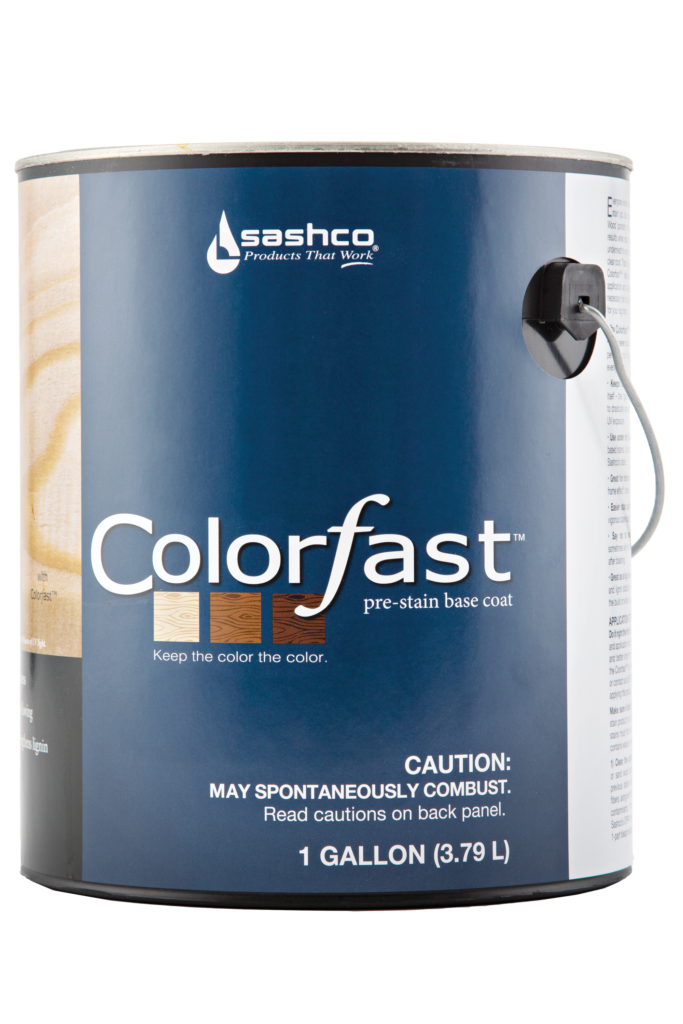
Keep the Color the Color Colorfast delivers the ideal canvas for stain application and leaves behind the strong foundation necessary for long-lasting color. It’s color confidence for your log home.
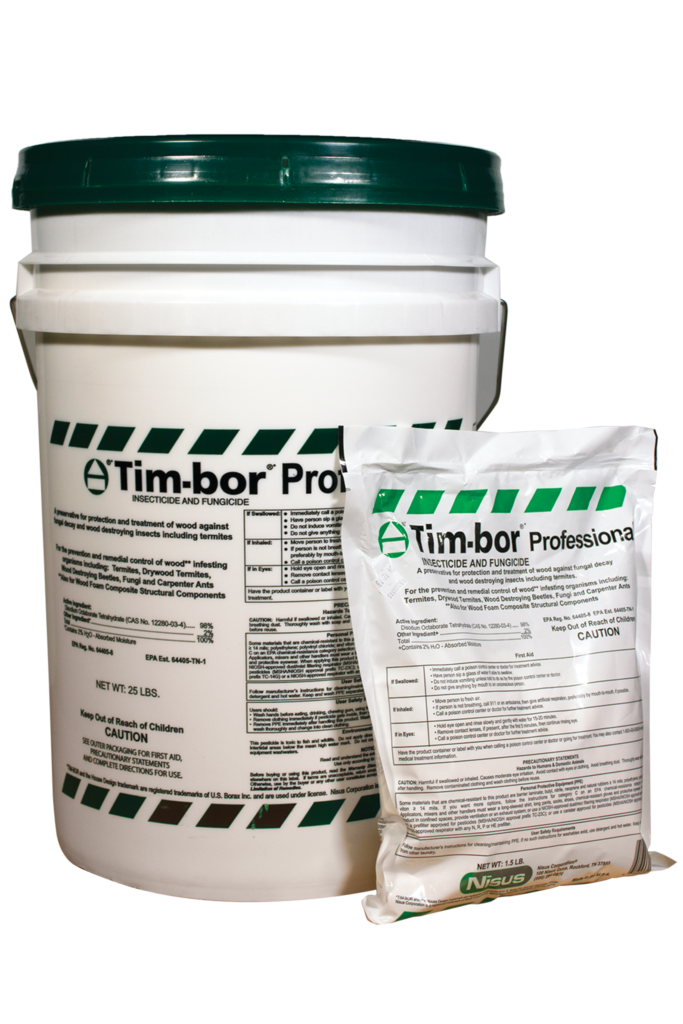
Rot, weather, insects, fungi all pose a serious threat to your logs. Protect your investment—treat your logs first to make them last. Tim-bor® helps protect your home from the costly damage caused by rot and insect infestation.
Bugs don't stand a chance
Easy to mix and apply
Prevents decay fungi
Costs 5 times less than glycol-based borate products
Remove Wood Felting and Raised Grain Remove wood fuzz (called felting) after power washing or media blasting, and knock down excessive raised grain with Sashco's finish sanding tools
Clean and brighten bare logs and wood, remove surface dirt, pollen, and kill mold for maintenance, and keep your logs looking fresh with CPR Log Cleaner and Brightener