Building a Better Log Home Business: Lessons Log Masters Restorations
Running a log home restoration company isn’t for the faint of heart. Log Masters Restorations has spent over a decade in the trenches, turning hard-earned experience into a system that actually works. Read on to see how their team’s lessons can help other businesses work smarter, not harder.
Why Log Home Restoration Businesses Need Specialized SOPs
Nick Smith, Dawn Smith, and Scott Futrell, have been in the log game since 2011, officially starting Log Masters Restorations in 2016. From the start, they realized that general construction knowledge wasn’t enough. Log homes are a different animal. They come with unique maintenance and restoration needs that require specialized knowledge.
“You actually need to know a little bit more about the nuances of log home restoration and maintenance repair, because they’re completely different than a conventional home,” Dawn explains.To build that knowledge, they dove into training, attending Sashco’s Zero Failures courses, both the Wood Science and the Business Focus. For Dawn, a self-proclaimed science nerd, the deep dive into how stains interact with wood was a blast. But beyond chemistry, the course offered practical, real-world advice for running a log home restoration business without losing your hair.
The Big Takeaway? Create Standard Operating Procedures
After leaving Zero Failures, one of the most obvious lessons Dawn and her team took away was the importance of having a standard. They got a vision and were determined to create what became their SOP (Standard Operating Procedures). With branches in Texas, Missouri, and Colorado, and crews traveling across regions, a clear standard wasn’t just a nice, “we’ll get around to it sometime,” kind of thing. It was absolutely necessary.
“If you don’t set up some kind of standard, you’ll have chaos. One guy does it one way, another guy another way, and suddenly you’ve got arguments on-site. The SOP keeps everyone on the same page,” Dawn says.
Starting small, they began drafting a simple SOP in 2021. Over time, it evolved into a comprehensive guide built from 15 years of experience, legal counsel advice, and industry insights. The SOP now helps onboard new crew members, standardize paperwork, and maintain high-quality work.
How Log Masters Documented Field Knowledge into Procedures
Building an SOP isn’t just about writing things down, it’s about capturing real-world knowledge and keeping it practical. We asked Dawn to share how they documented new insights from the field. Here are her tips (Aka, gold! Don’t sleep on this. These are tips that work!)”
1. How did you document new things from the field?
“In the beginning, our documentation system was very simple: Gmail, the HubSpot mobile app, QuickBooks Online, and one shared OneDrive account. Technicians would send photos and notes from their jobs each evening, and I would organize everything into reference material,” Dawn explained.
Over time, this evolved into educational blogs for their website and eventually expanded into a full documentation process using Gmail, QBO, HubSpot, and SharePoint for management, while technicians continue to use Gmail and Google Docs for quick updates.Dawn also spent time researching outside the company, reading Sashco’s blogs, industry articles, and monitoring Facebook log-home restoration groups daily. Initially for marketing, it became an incredibly helpful way to observe how others answered technical questions. Later, she worked in the field for a winter season to better understand challenges firsthand, documenting the nuances that formal training often misses.
2. Who was in charge of putting the SOP together?
Dawn led the creation of the SOP, but it could not have been built without Scott and Nick. They contributed years of field experience, solutions to unforeseen issues, and deep contract knowledge collected over the last 10–13 years. Their experience forms the backbone of much of the technical accuracy. Feedback from technicians and field staff also shaped the SOP. As the company grew, Dawn developed SOPs for new management positions as well. The SOP system is truly the combined result of the company’s lived experiences, lessons, and continuous learning.
3. How many reviews did it undergo?
The SOP system has just recently been completed, and 2025 marks their first formal company-wide review cycle. The week before Christmas, all LMR staff will review the Technician SOP together to finalize revisions before 2026.
4. Who’s responsible for reviewing and updating them regularly?
Dawn currently oversees all SOPs and will continue maintaining them with input from the management team. Each manager and staff member is responsible for reviewing their own SOP and suggesting edits. The company values employees’ insights, and their experience guides revisions over time.

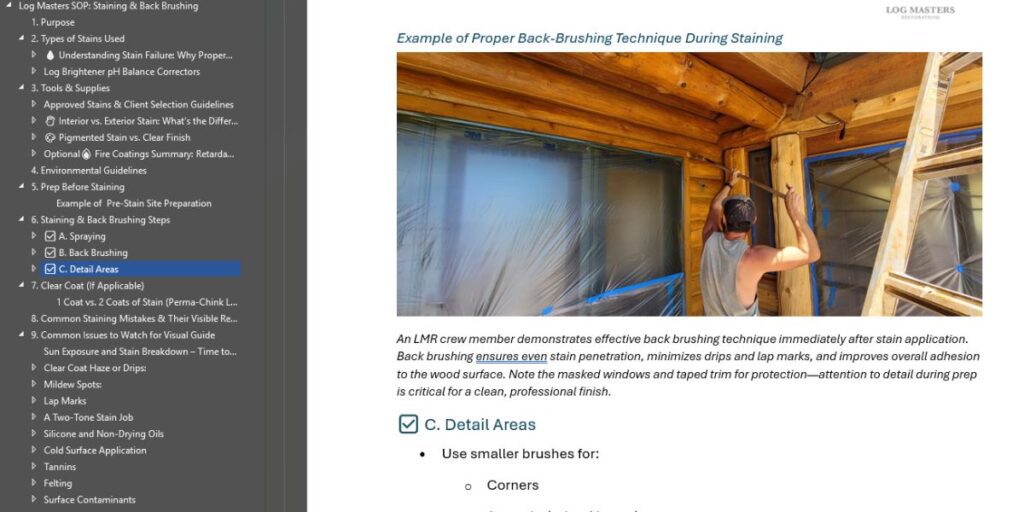
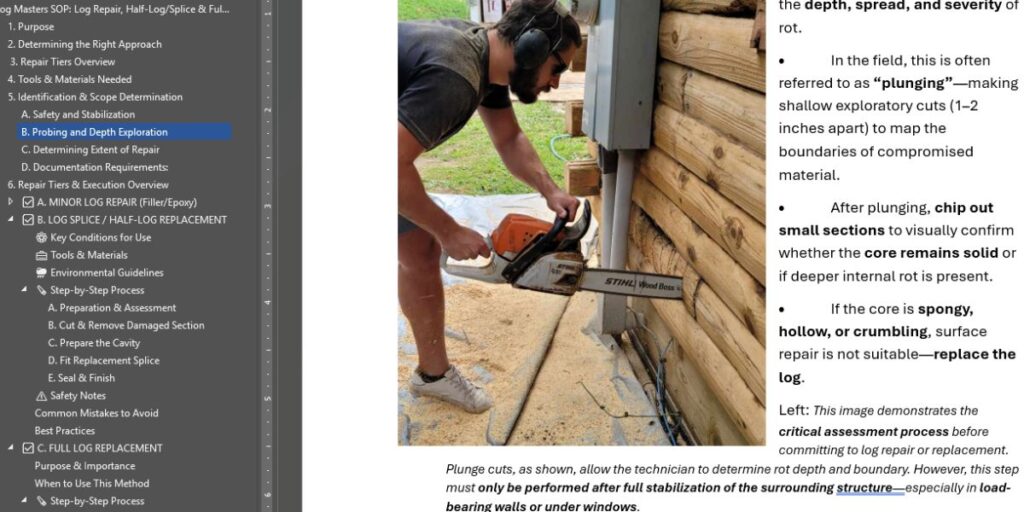
As Log Masters Restorations grows, staff see how their contributions also advance their own careers and help shape a workplace that values feedback, perspective, and boundaries. The 2026 KPI process will measure how effectively the SOPs work, whether they’re actively used, and where improvements are needed as products and techniques evolve. SOPs are only effective if they’re used, and KPIs provide real data, not assumptions.
The long-term goal is to stabilize the structure, strengthen what already works well, and ensure no one gets complacent as the company grows. Over time, this system will be passed on to the next generation of leadership.
Practical Advice for Contractors
Log Masters Restorations is generous with their tips for anyone building their own SOP or looking to improve operations:
- Start with the basics – Focus on the core tasks for each log home project before expanding to more complex scenarios.
- Document scenarios and solutions – Keep track of challenges you encounter and how you solve them. This becomes the foundation of your SOP.
- Engage your team – Field staff may have practical insights that don’t show up on paper. Their feedback ensures that procedures are realistic and effective.
- Be proactive, not reactive – An SOP isn’t just a guide; it’s a tool to anticipate issues and prevent costly mistakes (ahem, like broken specialty windows, more about that to come).
Patience is key – Mistakes will happen. Even after 15 years, new situations arise. Take time to adjust and refine your approach.
Case in point: a $10,000 specialty window destroyed during media blasting. Ouch. Expensive? Yes. Avoidable? Absolutely, thanks to covering windows with Ram Board going forward (now a standard part of their SOP). “Mistakes are opportunities to improve,” Dawn notes (and occasionally, to start questioning every life choice you’ve made before 10 a.m.).
The benefits of the SOP are tangible. Better structural organization, consistent recordkeeping, fewer callbacks, and smoother client communications (Who would take a hard pass on that? Nobody? We thought so.). The proactive approach ensures the team is prepared, and clients are satisfied. They even credit it for helping maintain the company’s five-star reputation.
Their Advice to Others
For Log Masters, the key to long-term success is simple: start small, document everything, engage your team, and be patient. Training, like the Zero Failures course, and collaboration with industry peers help build knowledge, while the SOP keeps it practical and actionable.
“Be patient with yourself. There’s always a new scenario, even after 15 years. Engage others in the industry, and don’t be afraid to ask for help. Start small, keep records, and let your mistakes teach you. That’s how you build something that works,” she says.
Building a successful log home restoration business isn’t just about skill. It’s about strategy, patience, and learning from every single project. Log Masters Restorations proves that taking the time to document, standardize, and actually involve your team isn’t overhead. It’s not busy work, and it’s definitely not a waste of time. It’s an investment that actually pays off. For contractors looking to level up, their story is a solid reminder that the right system doesn’t just keep chaos and wasted dollars at bay, it builds a smoother, smarter, and more profitable operation that can handle whatever a job throws your way.
Learn more about Log Masters Restorations at logmastersrestorations.com
Share this:

Ready to stain? Don’t guess! Sample. Testing stain colors on your actual logs before committing ensures that you get the exact look you want and helps prevent “oops” moments later. Snag your free samples here.
About Sashco Log Home Products
When it comes to protecting and beautifying your log home, Sashco isn’t just another stain on the market — it’s the high-performance choice for serious log lovers. With industry-leading products like Capture, Cascade, and Transformation, Sashco combines cutting-edge technology and rugged durability to keep your logs looking stunning and standing strong year after year. Whether you’re chasing that perfect finish or just want to avoid the heartbreak of costly repairs, Sashco’s got your back. Because your log home deserves more than “good enough,” it deserves Sashco. Made for logs. Made to last. Made to make your neighbors jealous.